Faustus of Riez is a saint of the Catholic Church. Faustus of Riez's feast day is celebrated on 28 September.
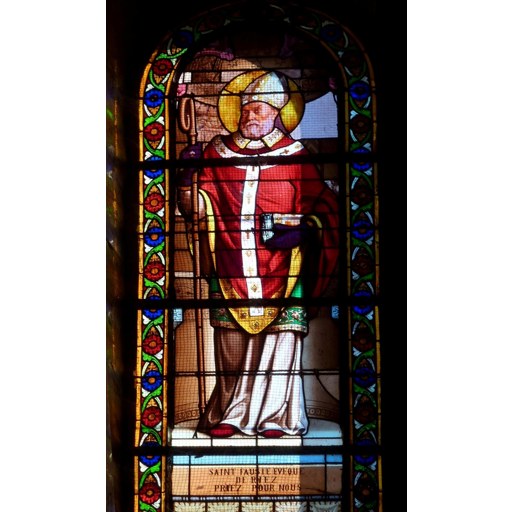
Reinhardhauke; shifted & cropped by Rabanus Flavus
License: CC BY-SA 3.0
Faustus of Riez
Saint- Feast Day
- 28 September
- Gender
- male
- Church
- Catholic
Places
Roles & Family
Biography
Faustus of Riez, known in Latin as Faustus Reiensis, was a fifth-century monk, abbot, bishop, and theologian whose career unfolded in southern Gaul and whose writings made him the most influential Latin spokesman of the theology later called Semi-Pelagianism. Contemporary Gallic authors, notably Sidonius Apollinaris and Avitus of Vienne, attest that he was a native of Britain. He left the island while still young, during the unsettled decades after the collapse of Roman administration there, and settled in Provence. He entered the monastery of Lérins, founded by Honoratus on an island off the Mediterranean coast, and was formed in the cenobitic life under Honoratus and Maximus. Ancient notices emphasize his austerity, his command of Scripture, and his literary education. When Maximus was made bishop of Riez, Faustus succeeded him as abbot of Lérins, probably in the early 430s; Hilary of Arles confirmed the election. As abbot he was already consulted on theological questions.
Faustus was consecrated bishop of Riez, in Provence, at some point between the early 450s and about 460, again as successor to Maximus. He took an active part in the synods of the Gallic church and acquired a reputation as a preacher and controversialist. He was a firm opponent of Arianism. When the Visigothic king Euric, himself an Arian, extended his authority over portions of Provence in the later fifth century, Faustus was forced into exile for several years and recovered his see only after Euric’s death in 484. Sidonius Apollinaris, bishop of Clermont, corresponded with him and extolled both his eloquence and his episcopal stature. Gennadius of Marseille, compiling his catalogue of ecclesiastical writers near the end of the century, still described Faustus as bishop of Riez and as the author of notable works.
The treatise that secured Faustus’s place in the history of doctrine is De gratia Dei et libero arbitrio, in two books. It was composed after a council at Arles, commonly dated to the 470s, had required a priest named Lucidus to recant opinions that seemed to deny human freedom and to ascribe reprobation to an unconditional divine decree. At the request of his fellow bishops, Faustus set out a middle way. He repudiated Pelagius’s claim that grace was unnecessary for salvation, yet he also refused those readings of Augustine that appeared to him to destroy free will and to teach predestination to damnation. He held that the beginning of faith could proceed from the human will, with divine grace subsequently aiding, cooperating, and bringing the work to completion. That scheme, akin to the teaching of John Cassian and characteristic of the Lérins tradition, was later termed Semi-Pelagian. Faustus further wrote De Spiritu Sancto in two books against those who denied the divinity of the Holy Spirit, as well as letters and sermons that circulated in Gaul.
Subsequent Western councils did not adopt his account of the initium fidei. In 529 the Second Council of Orange, guided by Caesarius of Arles, affirmed that even the beginning of faith is a gift of grace, while at the same time rejecting the proposition that God predestines anyone to evil. Faustus was not named in the Orange canons, and he continued to be venerated as a holy bishop in Provence. The precise year of his death is unknown. Gennadius, writing about 492, treats him as still alive; he probably died at Riez in the following years, before the close of the fifth century. A local cult is reflected in Gallican martyrologies, which commonly assign him the feast of 28 September, although other dates appear in some calendars. He belongs to the era of pre-congregational sanctity and was not the subject of a later papal canonization process. His career illustrates both the intellectual vitality of Lérins and the unsettled reception of Augustine’s later theology of grace in fifth-century Gaul.