Felicity is a saint of the Catholic Church (d. 203). Felicity's feast day is celebrated on 7 March. Felicity is the patron saint of mothers;expectant mothers;women in childbirth.
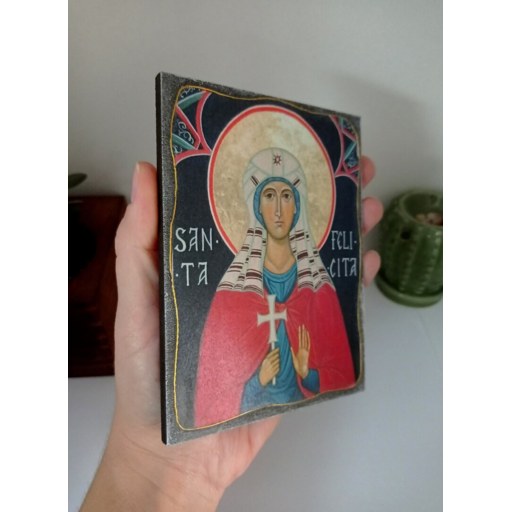
https://www.etsy.com/listing/926793545/saint-felicitas-of-rome-saint-felicity
License: unknown
Felicity
Saint- Life Span
- d. 203
- Feast Day
- 7 March
- Gender
- female
- Church
- Catholic
Places
Roles & Family
Patronage
mothers;expectant mothers;women in childbirth
Biography
Saint Felicity, also known as Felicitas, was an early Christian martyr who died at Carthage in the Roman province of Africa in the early third century. She is known almost exclusively from the Passion of Saints Perpetua and Felicity (Passio Sanctarum Perpetuae et Felicitatis), a Latin narrative that incorporates what appears to be Perpetua’s own prison diary together with an eyewitness account of the executions. In that text Felicity is described as a slave and as a companion of the well-born catechumen Vibia Perpetua. No reliable source records Felicity’s parentage, place of birth, or year of birth; she is simply presented as a member of the same Christian group arrested in Carthage.
According to the Passion, Felicity was pregnant when she was imprisoned, being in her eighth month. Because Roman custom did not permit the execution of a pregnant woman, her fellow prisoners feared that she would not share their martyrdom. After they prayed, she went into a difficult labor in the prison and gave birth to a daughter. A Christian woman then took the infant to raise. The group of catechumens—Perpetua, Felicity, Revocatus, Saturninus, and Secundulus—had been arrested during a persecution associated with the reign of Septimius Severus; their teacher Saturus later gave himself up to join them. They received baptism in custody. Secundulus died in prison; the others were condemned to the beasts.
The executions took place in the amphitheatre at Carthage, traditionally dated to 7 March 203, in connection with games for the birthday of Geta, son of the emperor. Felicity and Perpetua were matched with a wild cow. Both were thrown and injured; the Passion states that Felicity, after being tossed, got up and helped the dazed Perpetua to stand. The two women then exchanged the kiss of peace and were killed by the sword, as were their male companions after contests with other animals. The account emphasizes their composure and mutual support.
Veneration of Felicity and Perpetua began immediately in the African church. Their names were inserted into the Roman Canon of the Mass, among the few martyrs so honored in that ancient list. Saint Augustine preached several sermons on their anniversary in the early fifth century, indicating an established cult and a memorial at Carthage. In the modern Roman calendar their joint feast is kept on 7 March. Because Felicity endured childbirth in prison immediately before her death, later devotion has invoked her especially as a patron of mothers and of women in childbirth. Historians generally regard the Passion as substantially authentic, while remaining cautious about later legendary elaborations and about claims concerning the later whereabouts of relics.