Felix and Regula is a saint of the Catholic Church (d. 286). Felix and Regula's feast day is celebrated on 11 September. Felix and Regula is the patron saint of Zürich.
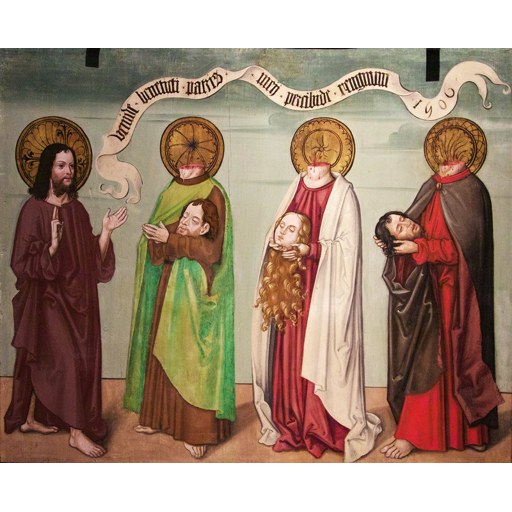
Zürcher Veilchenmeister
License: Public domain
Felix and Regula
Saint- Life Span
- d. 286
- Feast Day
- 11 September
- Church
- Catholic
Places
Roles & Family
Patronage
Zürich
Biography
Felix and Regula are a pair of early Christian martyrs venerated, together with their companion Exuperantius, as the patron saints of Zürich. No contemporary records of their lives survive, and what is known of them comes from a medieval passion legend, whose written form is not attested before the eighth century. According to that tradition they were siblings who belonged to the Theban Legion, a Roman unit said to have been recruited in Thebes in Egypt and to have consisted of Christians under the command of Saint Maurice. The legion was believed to have been massacred at Agaunum (present-day Saint-Maurice in the Valais) around 286, after refusing orders incompatible with their faith. Felix, Regula, and their servant Exuperantius were said to have escaped the slaughter and fled north through the Alps.
The fugitives eventually reached the Roman vicus of Turicum, on the site of modern Zürich. Later accounts describe them living there as hermits and baptizing converts in the river Limmat. They were discovered by the Roman authorities, arrested, and brought before a governor who in some versions of the story is named Decius. After they refused to sacrifice to the pagan gods they were tortured and beheaded on the riverbank. The legend then records a cephalophoric miracle: the three martyrs picked up their own severed heads and walked some forty paces uphill to the place where they wished to be buried, and there they lay down. The execution site was later marked by the Wasserkirche; the burial site became the location of the Grossmünster.
The cult of Felix and Regula is well attested in the early medieval period even though the passion narrative itself cannot be treated as recoverable biography. Tradition ascribes the foundation of the Grossmünster to Charlemagne, who was said to have found the graves after his horse knelt at the spot. By the high Middle Ages the Grossmünster, the Fraumünster, and the Wasserkirche formed a sacred topography of Zürich centered on the martyrs. Their relics were displayed and carried in procession, and their feast on 11 September was a principal holiday of the city. In 1524, during the Reformation under Huldrych Zwingli, the relics were taken from their shrines and thrown into the Limmat as an act of iconoclasm; according to some later reports, portions were recovered and removed elsewhere, including to Andermatt.
Felix and Regula remain the patron saints of Zürich. They are commemorated on 11 September in the Roman Martyrology and are also venerated in the Coptic Orthodox tradition by virtue of the Theban origin ascribed to them. Images of the cephalophoric siblings, often shown carrying their heads, appear in Zürich’s civic and ecclesiastical art from the Middle Ages onward, including on the city’s seal and in the decoration of the Grossmünster. Modern historians regard the Theban Legion story and the Zürich passion as pious legend rather than documented history, but the cult is of genuine importance for the religious and civic history of medieval and early modern Switzerland.