Felix III is a saint of the Catholic Church (d. 492). Felix III's feast day is celebrated on 1 March.
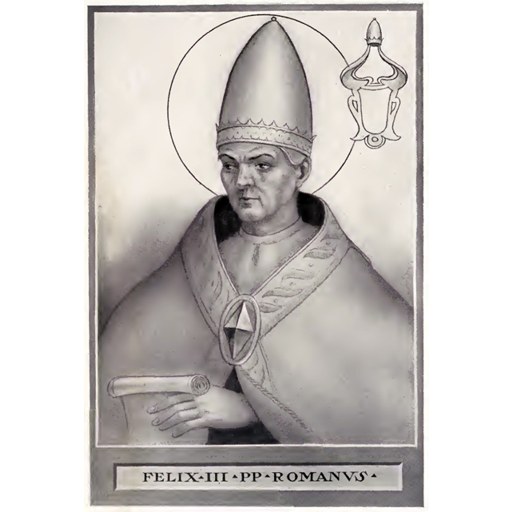
Artaud de Montor (1772–1849)
License: Public domain
Felix III
Saint- Life Span
- d. 492
- Feast Day
- 1 March
- Gender
- male
- Church
- Catholic
Places
Roles & Family
Biography
Felix III was Bishop of Rome from 483 until his death in 492. A Roman of senatorial standing, he is described in the Liber Pontificalis as natione Romanus and as the son of a priest also named Felix. No reliable source records the year of his birth, and none should be inferred from the date of his election. Before advancing in the Roman clergy he had been married and was the father of children; later Roman tradition, including the testimony of Pope Gregory I, counted Felix among the ancestors of Gregory’s family. In the fifth-century Roman church, aristocratic birth and an earlier married life were not unusual among men who later held high office, even as the ideal of clerical continence was increasingly urged.
He succeeded Pope Simplicius and was consecrated on 13 March 483, when Italy was under the rule of Odoacer. The central conflict of his pontificate was with the imperial church in the East. In 482 Emperor Zeno, acting with Patriarch Acacius of Constantinople, issued the Henotikon, a reunion formula that affirmed the first three ecumenical councils, avoided a clear endorsement of the Council of Chalcedon (451) and of the Tome of Leo, and was meant to conciliate opponents of Chalcedon in Egypt and Syria. Felix treated the edict as a betrayal of Chalcedon. He required an account from Acacius and, after Acacius remained in communion with Peter Mongus of Alexandria, a Roman synod in 484 declared Acacius deposed and excommunicated. Two papal legates, Vitalis and Misenus, sent earlier to Constantinople, were detained, pressured, and induced to communicate with Acacius; Felix had them condemned on their return, though Misenus was later restored to communion. Acacius removed Felix’s name from the diptychs. The resulting Acacian schism lasted until the restoration of communion between Rome and Constantinople in 519.
In the West, Felix addressed the aftermath of Vandal persecution in North Africa. Under Huneric many Catholics had been exiled or had yielded to Arian pressure. When conditions eased, African bishops and clergy sought Roman guidance on the status of the lapsed and of those ordained outside Catholic communion. Felix issued disciplinary rules for their reconciliation, requiring penance for those who had compromised while still opening a path back to the church, and thereby asserted Rome’s appellate role in African affairs even though political control of the region remained in Vandal hands.
He died in Rome on 1 March 492 and, according to the Liber Pontificalis, was buried in the basilica of Saint Paul on the Ostian Way, on the kalends of March. Gelasius I, who had worked closely with him, succeeded him. Felix has been commemorated as a saint from an early date; his feast is 1 March. Because an earlier Felix (an antipope during the exile of Liberius) was sometimes inserted into papal lists, this pope has occasionally been styled Felix II, but in the standard numbering he is Felix III. His pontificate is remembered for the uncompromising Roman defence of Chalcedon that opened the Acacian schism, for his African disciplinary legislation, and for the later claim of kinship with Gregory the Great.