Felix of Nantes is a saint of the Catholic Church (512 - 584). Felix of Nantes's feast day is celebrated on 7 July. Felix of Nantes is the patron saint of Nantes.
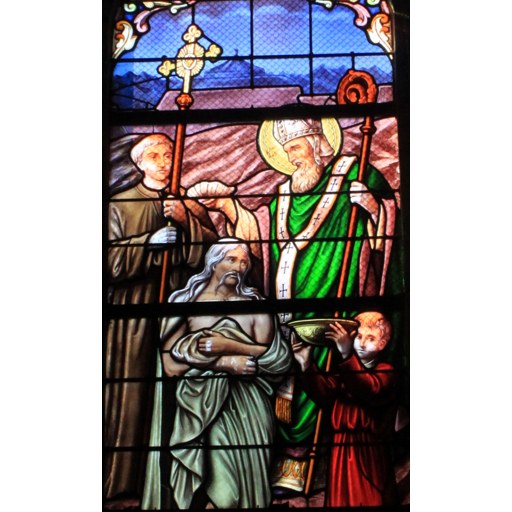
Llann Wé²
License: CC BY-SA 3.0
Felix of Nantes
Saint- Life Span
- 512 - 584 (age 72)
- Feast Day
- 7 July
- Gender
- male
- Church
- Catholic
Places
Roles & Family
Patronage
Nantes
Biography
Felix of Nantes was a Gallo-Roman aristocrat of senatorial rank who became bishop of Nantes in the mid-sixth century, in Merovingian Gaul. Later tradition, relying especially on the poems of Venantius Fortunatus, places his origin in a distinguished family connected with Bourges in the territory of the Bituriges. He is presented in the sources as a layman of education and property who entered the episcopate in adulthood rather than as a career monk. Around the middle of the century, commonly dated to 549, he succeeded Bishop Evemerus (also called Eumerius) on the see of Nantes, a Roman-founded city on the lower Loire at the meeting of Frankish Neustria and the Breton west. Fortunatus, the Italian poet then established at Poitiers, addressed several poems to him; Gregory of Tours, who knew him personally, remarked on his eloquence and sharpness of mind. Together those two contemporaries are the principal witnesses to his life.
As bishop, Felix is remembered above all as a builder. He constructed a new cathedral at Nantes, dedicated to Saint Peter, whose dedication Fortunatus commemorated in verse, describing a substantial church with a carefully wrought roof and a luminous interior of a kind typical of ambitious sixth-century Gallic sees. Poetic and later hagiographical tradition also associates him with works of urban improvement, including the management of watercourses along the Loire and the Erdre, intended to protect or embellish the city. His episcopate lasted several decades, from about the mid-sixth century until his death in the early 580s. In that time he carried out the ordinary business of a Merovingian bishop: administration of church estates, maintenance of urban cult, and dealings with neighboring peoples. Later accounts credit him with disciplinary or missionary activity among the Bretons of Armorica, on the western margins of his diocese.
The most intimate, and not always flattering, portrait comes from Gregory of Tours. In the Histories Gregory depicts Felix as learned and capable but quarrelsome where property was concerned. A well-known episode involves a dispute over ecclesiastical estates, in which Gregory accused him of greed and of seeking to annex goods that did not belong to the church of Nantes; the two bishops exchanged sharp words. Gregory also records Felix’s involvement in the tangled politics of the Frankish kingdoms and in local conflicts over inheritance and church rights. Such passages belong to Gregory’s episcopal world, in which literacy, holiness, and hard-headed administration of land were not easily separated. Later liturgical and hagiographical tradition softened the picture, presenting Felix as a builder-bishop and a saint of the Loire rather than as the contentious grandee of Gregory’s narrative.
Felix died at Nantes, according to the usual reckoning in 584 (some reconstructions, following Gregory’s chronology of a thirty-three-year episcopate beginning about 549, prefer 582), traditionally on 8 January. He was buried in the cathedral he had built. A local cult grew up around his tomb. The Roman Martyrology and the liturgical tradition of Nantes commemorate him on 7 July, which is generally taken as the date of a translation of relics or as the principal feast; some calendars also note 8 January as the day of his death. He was never the subject of a formal papal canonization of the later medieval type: his sainthood belongs to the older pattern of episcopal cultus in Gaul, later received into the wider martyrological tradition. Relics associated with him were kept at Nantes. Beyond his role as holy bishop and patron of that city, the sources do not attach to him a wide range of specialized patronages. The evidence for his life remains the poems of Fortunatus, the narrative of Gregory of Tours, and the episcopal memory of the church of Nantes.