Ferdinand the Holy Prince is a blessed of the Catholic Church (1402 - 1443). Ferdinand the Holy Prince's feast day is celebrated on 5 June.
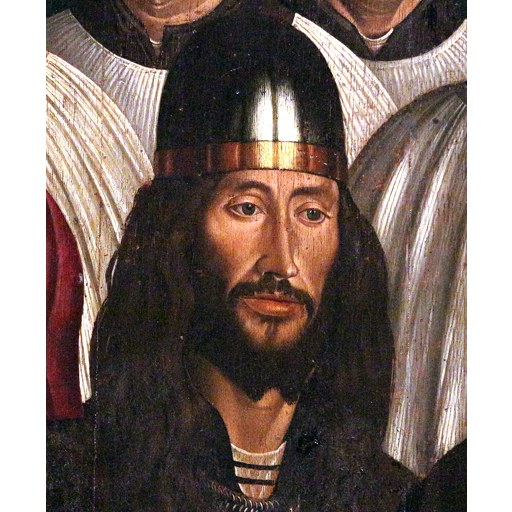
Nuno Gonçalves
License: Public domain
Ferdinand the Holy Prince
Blessed- Life Span
- 1402 - 1443 (age 41)
- Feast Day
- 5 June
- Gender
- male
- Church
- Catholic
Places
Relics & Where to Venerate
Location unknown
The bodily remains of Ferdinand the Holy Prince are a first-class relic. Venerated at Batalha Monastery.
Housed at Batalha Monastery · Portugal
Frei João Álvares and João Rodrigues were instructed to take the relics and deposit them in the prepared tomb reserved for Ferdinand in the Aviz necropolis, the Founder's Chapel in Batalha Monastery
Location unknown
Frei João Álvares and João Rodrigues were instructed to take the relics and deposit them in the prepared tomb reserved for Ferdinand in the Aviz necropolis, the Founder's Chapel in Batalha Monastery
Roles & Family
Religious Information
Canonization
Biography
Ferdinand, known in Portuguese as the Infante Santo or Holy Prince, was born in 1402 at Santarém in the Kingdom of Portugal, the youngest surviving son of King John I of Aviz and Queen Philippa of Lancaster. Through his mother he was a grandson of John of Gaunt, Duke of Lancaster, and thus a great-grandson of King Edward III of England, a connection that tied the new Aviz dynasty to the English royal house after the Anglo-Portuguese alliance of the late fourteenth century. He belonged to the generation later called the Ínclita Geração, or Illustrious Generation: his surviving siblings included Edward, who succeeded as king; Peter, Duke of Coimbra; Henry the Navigator; John, later Constable of Portugal; and Isabella, who became Duchess of Burgundy. The court in which he was raised combined the military and administrative energy of John I, founder of the dynasty after Aljubarrota, with the devout, disciplined household culture associated with Philippa of Lancaster. Ferdinand was still a child when Ceuta was taken in 1415 and when his mother died that same year; he did not share in that first North African campaign, which was led by his father and elder brothers.
As a young infante he received a careful education and showed a strong inclination toward prayer, study, and an austere personal life. He did not marry and had no children. In 1434 he was given the administration of the Military Order of Aviz, the religious-military order of which his father had been master before taking the crown. He also held lordships that included Salvaterra de Magos and Atouguia. Near-contemporary testimony, above all the account later written by his secretary Frei João Álvares, who shared part of his captivity, describes him as learned, reserved, and unusually devout for a royal prince, more drawn to spiritual concerns than to dynastic marriage or factional politics. During the short reign of his brother King Edward he remained a secondary figure at court, a pious bachelor infante rather than a rival for power.
In 1437 Ferdinand joined the Portuguese expedition against Tangier, an enterprise strongly associated with his brother Henry. The attack failed. The army was trapped, and in order to secure a withdrawal the Portuguese commanders accepted terms under which Ceuta would be restored to its former rulers and Ferdinand would remain in Moroccan hands as a hostage guaranteeing the agreement. He was accordingly left behind. King Edward died in 1438, leaving a minor heir, Afonso V, and a contested regency. The Portuguese Cortes and the subsequent government of the realm refused to surrender Ceuta, the North African city taken in 1415 and regarded as too valuable to yield even for the infante’s freedom. Ferdinand therefore remained a prisoner.
He was held for nearly six years, first in coastal strongholds and then in Fez, under the authority of the Marinid regime in which the Wattasid vizier Abu Zakariya Yahya al-Wattasi was the dominant figure. Once it was clear that Ceuta would not be given up, his captivity hardened into prolonged imprisonment, humiliation, and forced labor. He was pressed to abandon Christianity and refused. Álvares and later Portuguese tradition emphasize his patience, his maintenance of Christian practice in prison, and his care for fellow captives. Those years, from the disaster at Tangier until 1443, are the basis of his reputation for holiness: a royal hostage whose suffering was interpreted as the price Portugal paid to keep Ceuta.
Ferdinand died in Fez on 5 June 1443. After his death his body was publicly displayed by his captors. His remains were later recovered and, in the 1470s, brought back to Portugal and buried in the Founder’s Chapel of the Monastery of Batalha, the dynastic necropolis of John I and Philippa, beside his parents and brothers. In 1470 Pope Paul II authorized public veneration of the infante, a confirmation of cult that later tradition treats as his beatification. He was never formally canonized. In Portugal he has long been honored as the Infante Santo, with a feast on 5 June, and his story was fixed for later readers by Álvares’s biography and by Aviz dynastic memory, which presented him as a martyr-like prince whose captivity and death had been bound up with the retention of Ceuta.