Filaret is a saint of the Catholic Church (b. 1929).
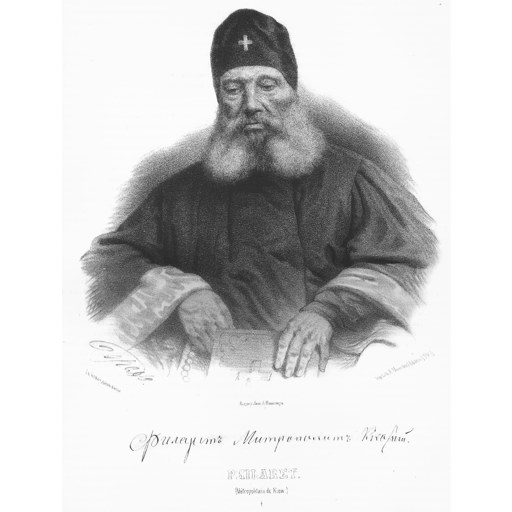
Unknown authorUnknown author
License: Public domain
Filaret
Saint- Life Span
- b. 1929
- Gender
- male
- Church
- Catholic
Places
Roles & Family
Biography
Filaret, born Mykhailo Antonovych Denysenko on 23 January 1929 in the village of Blahodatne in Donetsk Oblast of the Ukrainian Soviet Socialist Republic, rose through the ranks of the Russian Orthodox Church to become one of the most influential and contentious hierarchs in the Orthodox world of the late twentieth and early twenty-first centuries. After studies at the Odessa Theological Seminary and the Moscow Theological Academy, he was tonsured a monk in 1950, taking the name Filaret, and was ordained to the diaconate and priesthood. He served in academic posts, including as rector of the Moscow Theological Academy, and in 1962 was consecrated to the episcopate. He held the sees of Luga (as a vicar of Leningrad) and of Vienna and Austria, then served as bishop of Dmitrov and rector in Moscow. Appointed to the ancient see of Kyiv in 1966 as archbishop and exarch of Ukraine, he was elevated to metropolitan and for a quarter century headed the Ukrainian Exarchate of the Moscow Patriarchate, becoming a permanent member of the Holy Synod of the Russian Orthodox Church and an active participant in the World Council of Churches and other ecumenical bodies.
In 1990, following the death of Patriarch Pimen, Metropolitan Filaret served as locum tenens of the Moscow patriarchal throne until the election of Patriarch Alexy II, to whom he lost in the patriarchal election. The collapse of the Soviet Union and the independence of Ukraine in 1991 transformed the ecclesiastical landscape. Filaret sought autocephaly for the Ukrainian church from Moscow. When a bishops' council in Kharkiv in May 1992 deposed him and elected Metropolitan Volodymyr (Sabodan) in his place, Filaret refused to accept the decision. The Russian Orthodox Church subsequently defrocked him. Together with supporters and with part of the Ukrainian Autocephalous Orthodox Church, he participated in the creation of the Ukrainian Orthodox Church - Kyiv Patriarchate. After the deaths of Patriarch Mstyslav (Skrypnyk) and Patriarch Volodymyr (Romaniuk), Filaret was elected Patriarch of Kyiv and All Rus-Ukraine in 1995. The Moscow Patriarchate and the majority of autocephalous Orthodox churches did not recognize this election or the Kyiv Patriarchate as canonical; in 1997 the Russian Orthodox Church formally anathematized him.
For more than twenty years Filaret led the Kyiv Patriarchate as a vehicle of Ukrainian national Orthodoxy, independent of Moscow. His leadership coincided with the religious revival and nation-building of independent Ukraine, and he became a highly visible public figure. In 2018 the Ecumenical Patriarchate of Constantinople, in the course of preparing a tomos of autocephaly for a unified Ukrainian church, lifted the anathema imposed by Moscow and restored Filaret to communion as a former metropolitan, without recognizing him as a patriarch. At the unification council of December 2018 that established the Orthodox Church of Ukraine, Metropolitan Epiphanius was elected metropolitan of Kyiv; Filaret received the title of honorary patriarch. Disputes over authority, property, and the statutes of the new church soon led Filaret to break with the OCU. In 2019 he convened gatherings that purported to restore the Kyiv Patriarchate, a move rejected by the OCU, by Constantinople, and by Ukrainian state authorities who had recognized the OCU.
Filaret's career has been marked by persistent controversy. Critics, especially in the Moscow Patriarchate, accused him of violating monastic celibacy, of administrative authoritarianism, and of schism. Supporters have portrayed him as a defender of Ukrainian ecclesiastical independence against Russian domination. He remained at the head of a reduced Kyiv Patriarchate structure into his nineties. His long life spans the Stalinist period, the late Soviet era, Ukrainian independence, the granting of autocephaly by Constantinople, and the subsequent fragmentation of Ukrainian Orthodoxy, making him a central if polarizing witness to the entanglement of church, nation, and geopolitics in Eastern Europe.