Finbarr of Cork is a saint of the Catholic Church (d. 623). Finbarr of Cork's feast day is celebrated on 25 September. Finbarr of Cork is the patron saint of Cork;Diocese of Cork;Diocese of Cork and Ross.
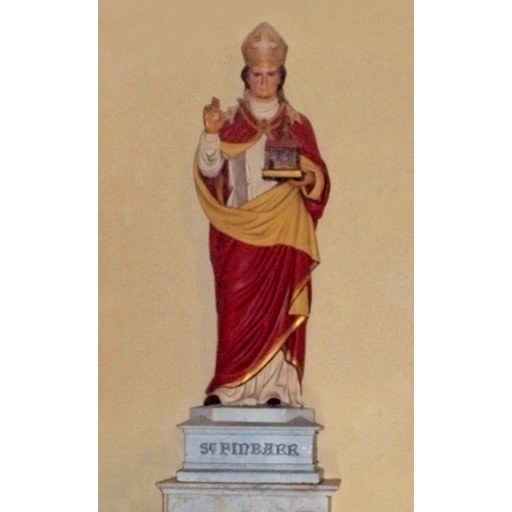
Carsten Hemberger, derivate Hic et nunc
License: CC BY-SA 3.0
Finbarr of Cork
Saint- Life Span
- d. 623
- Feast Day
- 25 September
- Gender
- male
- Church
- Catholic
Places
Sacred Place

Roles & Family
Patronage
Cork;Diocese of Cork;Diocese of Cork and Ross
Biography
Saint Finbarr (also Finbar, Finnbarr, Barr, or Barra; Irish Fionnbarra, meaning fair-headed) is the early medieval Irish saint honoured as founder of the monastic settlement from which the city of Cork grew, and as first bishop of Cork. He is the patron of the city and of the Diocese of Cork. Surviving accounts of his life depend largely on later medieval hagiography, especially Irish and Latin Lives compiled centuries after the period in which he is placed, so that a precise year of birth and many narrative details cannot be independently verified. Tradition situates him in the sixth and early seventh centuries and commonly assigns his death to 623. His feast is kept on 25 September.
According to the traditional Lives, he was born in Munster, often at Templemartin near Bandon in what is now County Cork, and was at first named Lóchán (or Loan). His father, Amergin of Maigh Seóla, is described as a craftsman from the region of Lough Corrib in Connacht; stories of his mother’s status vary, and some older reference works therefore place his origin in Connacht rather than Munster. He is said to have been educated in Leinster or Ossory—Kilmacahil in County Kilkenny is frequently named—where the monks called him Fionnbarra because of his fair hair. Hagiography also sends him on pilgrimage to Rome and on a visit to Saint David in Wales, journeys that belong to the conventional repertoire of Irish saints’ Lives rather than to a demonstrable itinerary.
After his formation he lived as a hermit. The site most closely associated with this phase is Gougane Barra, a remote lake-island in the mountains of West Cork at the source of the River Lee, where a hermitage and later a small church commemorated him. From the upper Lee he is said to have moved downstream and established a monastery on the marshy ground (Irish corcach) that gave Cork its name. That community, of which he is regarded as abbot-bishop, became a noted school and the ecclesiastical core of the later town. As with other early Irish founder-saints, later legend attributed miracles to him, including the clearing of a serpent or monster from the lake at Gougane Barra. He belonged to the native Irish monastic church of his age rather than to any later named religious order.
Tradition holds that he died at Cloyne (Cluain Uamha) in County Cork and that his body was brought to Cork for burial at his own monastery. The medieval cathedral, and the present Church of Ireland cathedral of Saint Fin Barre, occupy that site. His cult was firmly established in Munster by the later Middle Ages; modern scholarship, notably the studies of Pádraig Ó Riain, has stressed how twelfth-century ecclesiastical politics and the possible conflation of several saints named Findbarr or Barr shaped the written Lives. Nonetheless, Finbarr remains the principal patron of Cork. Gougane Barra is still a place of pilgrimage, and both the Catholic Diocese of Cork and Ross and the Church of Ireland Diocese of Cork, Cloyne and Ross keep his memory. Because almost all narrative detail derives from late Lives rather than contemporary records, the historian can affirm with confidence only that an important early church at Cork claimed an abbot-bishop founder whose cult, under the name Finbarr or Barr, was celebrated on 25 September and had become central to the city’s Christian memory by the high Middle Ages.