Firmus is a saint of the Catholic Church. Firmus's feast day is celebrated on 9 August. Firmus is the patron saint of Verona.
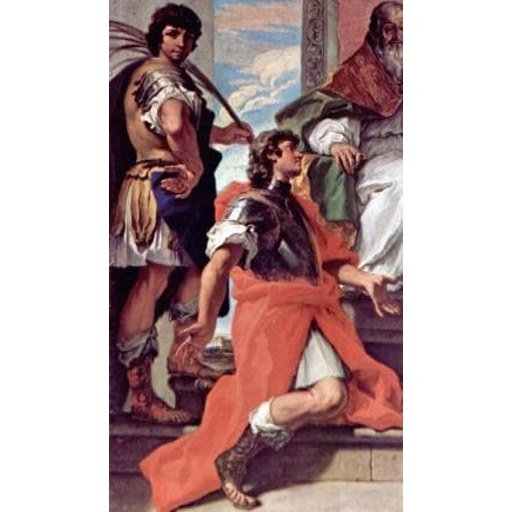
https://saintforaminute.com/saints/saint_firmus_of_verona
License: unknown
Firmus
Saint- Feast Day
- 9 August
- Gender
- male
- Church
- Catholic
Places
Roles & Family
Patronage
Verona
Biography
Saint Firmus, almost always commemorated together with Saint Rusticus, is an early Christian martyr whose cult is firmly rooted in Verona in northern Italy. No contemporary biography survives. What later ages knew of him comes from a medieval passio and from the civic and liturgical memory of Verona, which by the early Middle Ages already treated Firmus and Rusticus as local martyrs. According to that tradition they were Christians of noble family from Bergamo who were arrested at Verona during the persecutions associated with the emperors Diocletian and Maximian, that is, in the late third or early fourth century. Their exact year of birth is unknown, and no reliable source records parents, a spouse, children, or membership in a religious order. They are presented as laymen, not as bishops, monks, or clergy of high rank.
The legendary narrative states that Firmus and Rusticus refused to sacrifice to the pagan gods. They were tortured and finally beheaded near the river Adige. Local Christians were said to have recovered and buried the bodies. In the eighth century Bishop Annone of Verona is credited with a solemn translation of the relics, an event that greatly strengthened the cult. Over their resting place rose the church of Santi Fermo e Rustico, rebuilt in later centuries as the present Romanesque-Gothic basilica, which remains one of Verona’s principal churches and still houses relics associated with the two martyrs. The Roman Martyrology assigns their feast to 9 August. They have long been honored as patrons of Verona, alongside Saint Zeno, and appear in medieval and early modern liturgical books, sermons, and civic ceremonies of the Veneto.
Historians treat the passio with caution. It is not a fourth-century document, and many of its narrative details cannot be verified. The historical kernel—that Christians named Firmus and Rusticus were remembered as martyrs at Verona, and that their relics became the focus of an important local cult—is secure from the early medieval evidence onward. Precise chronology is not. Writers often place the deaths in the Great Persecution around the beginning of the fourth century, but that dating is conventional rather than documented. Iconography typically shows two young laymen with the palm of martyrdom and the sword of beheading. The cult did not generate a religious order or a wide international following, though the names entered Western martyrologies. Firmus was neither pope nor patriarch. His significance is that of an early witness whose memory was preserved by a Veronese liturgical and civic tradition that is itself historically well attested, even where the biography remains largely legendary.