Flavian of Constantinople is a saint of the Catholic Church (d. 449). Flavian of Constantinople's feast day is celebrated on 18 February.
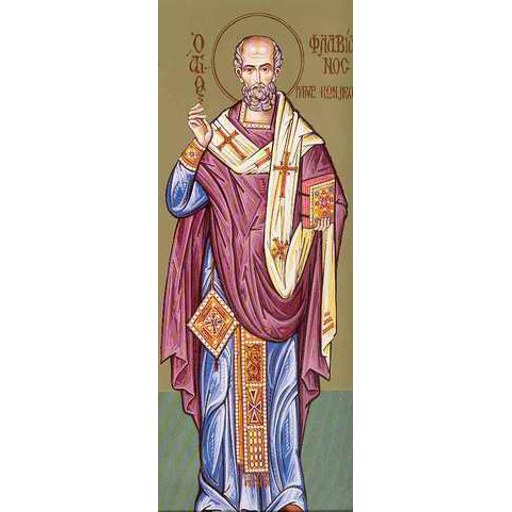
AnonymousUnknown author
License: Public domain
Flavian of Constantinople
Saint- Life Span
- d. 449
- Feast Day
- 18 February
- Gender
- male
- Church
- Catholic
Places
Roles & Family
Biography
Flavian of Constantinople, venerated as a saint in both Eastern and Western Christianity, was Archbishop of Constantinople in the mid-fifth century. The year and place of his birth are not recorded in surviving sources, and nothing reliable is known of his family or education. He first appears as a priest of the church of the imperial capital, where he had a reputation for austerity and integrity. In 446, after the death of Patriarch Proclus, he was elected to the see of Constantinople. His short episcopate unfolded in the Eastern Roman Empire under Emperor Theodosius II, when christological disputes that had followed the Council of Ephesus of 431 were still unresolved and rivalry between Alexandria and Constantinople was intense.
The central conflict of his patriarchate concerned the archimandrite Eutyches, an elderly monastic superior in Constantinople who had influence at court through the chamberlain Chrysaphius. Eutyches taught that after the Incarnation Christ had only one nature and rejected language of two natures. In November 448 Flavian presided over a synod of bishops then in the capital. Eutyches was examined, condemned, deposed, and excommunicated. He appealed to Pope Leo I of Rome and found a powerful ally in Dioscorus of Alexandria, who treated the verdict as an attack on the theology of Cyril of Alexandria and on Alexandrian standing. Leo answered with a doctrinal letter to Flavian, later called the Tome of Leo, affirming that Christ is one person in two natures, divine and human, without confusion or separation. Political conditions in the East kept that letter from shaping the next assembly.
In 449 Theodosius II summoned a council to Ephesus. Dioscorus dominated the gathering, which opened in August 449. Papal legates were present, but the Tome of Leo was not read. Flavian and his supporters were denied a free defence. The assembly restored Eutyches, deposed Flavian and bishops aligned with him, including Eusebius of Dorylaeum, and relied on intimidation. Ancient reports later received at Chalcedon state that Flavian was beaten by soldiers and by monks associated with the archimandrite Barsauma. He was sentenced to exile. According to a widespread tradition he died of his injuries in 449 at Hypaepa in Lydia in western Asia Minor. Before his death he appealed to Rome. Pope Leo I rejected the acts of Ephesus 449 and called the meeting a latrocinium, a robber council rather than a true synod.
The political situation changed when Theodosius II died in 450. Pulcheria and the new emperor Marcian favoured the Roman and Constantinopolitan position. The Council of Chalcedon in 451 reversed the decisions of 449, condemned Eutyches, deposed Dioscorus, and restored Flavian’s memory. It received the Tome of Leo and defined two natures in one person. Flavian was honoured as a confessor of orthodox teaching; later devotion regarded him as a martyr because of the violence at Ephesus and his death as a result of it. His relics were brought to Constantinople and, according to ecclesiastical historians, enshrined in the Church of the Holy Apostles. He is commemorated on 18 February in the Roman Martyrology and in Eastern calendars, with some Orthodox usage also noting 16 February. No reliable ancient source gives him a birth year, a birthplace, a spouse, or children; he is known through his brief patriarchate and its violent end.