Folquet de Marseille is a blessed of the Catholic Church (d. 1231).
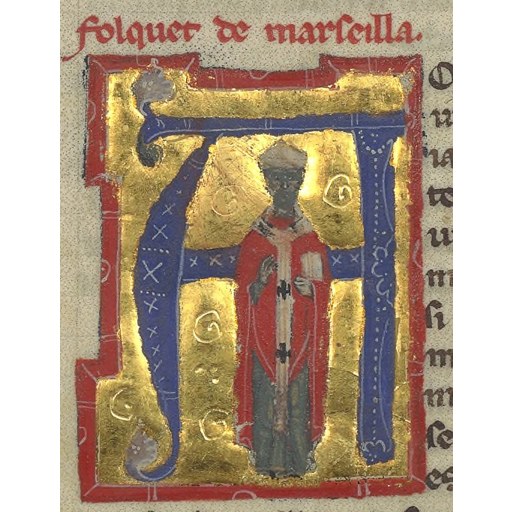
Unknown authorUnknown author
License: Public domain
Folquet de Marseille
Blessed- Life Span
- d. 1231
- Gender
- male
- Church
- Catholic
Places
Roles & Family
Religious Information
Biography
Folquet de Marseille, known in Occitan as Folquet de Marselha and in later ecclesiastical sources as Foulques of Toulouse, was born in Marseille in Provence in the mid-twelfth century. His family was of Genoese mercantile origin and had established itself in the port city, where Folquet followed a commercial career and accumulated substantial wealth. At the same time he became one of the leading troubadours of his generation. His surviving lyric output consists chiefly of cansos, together with a smaller number of other compositions; the poems are notable for their formal control and for a tone that is often more reflective or moralizing than that of many of his contemporaries. He frequented the courts of Barral des Baux, viscount of Marseille, of Alfonso II of Aragon, and of Raymond V of Toulouse, and his reputation as a poet was high in the decades before 1200.
Around 1195 Folquet experienced a religious conversion that led him to renounce both trade and secular song. He entered the Cistercian abbey of Le Thoronet in Provence. Notices of his life indicate that his wife became a nun and that two sons entered Cistercian monasteries. Within the order he advanced rapidly. About 1205 he was made abbot of Grandselve, a major Cistercian house in the region of Toulouse. In the same year he was elected bishop of Toulouse, and he occupied that see until his death more than a quarter-century later.
As bishop, Folquet was a resolute opponent of the Cathar religious movement then widespread in Languedoc and a supporter of the Albigensian Crusade that began in 1209. He worked with Dominic de Guzmán in the first years of the Order of Preachers, whose mission of preaching against heresy took shape in and around Toulouse. He was connected with the establishment of a university at Toulouse, intended in part to strengthen orthodox teaching in the region. In 1215 he took part in the Fourth Lateran Council. His episcopate unfolded amid war, confiscations, and the collapse of the old princely order of the Midi; medieval Catholic writers commended his zeal, while some modern historians of Occitania have judged his alliance with the crusade harshly.
Folquet died on 25 December 1231 and was buried at Grandselve Abbey. He was not formally canonized by the papacy, though he was remembered in Cistercian circles and in local tradition. Dante Alighieri assigned him a place among the blessed in the Heaven of Venus in the Paradiso, depicting him as a man who had passed from worldly love to the love of God. Through his poems, his monastic career, and his long tenure as bishop of Toulouse, Folquet stands as a well-documented link between the courtly culture of the twelfth-century troubadours and the reforming, crusading Latin Church of the early thirteenth century.