Francis Fasani is a saint of the Catholic Church (1681 - 1742). Francis Fasani's feast day is celebrated on 29 November. Francis Fasani is the patron saint of Lucera.
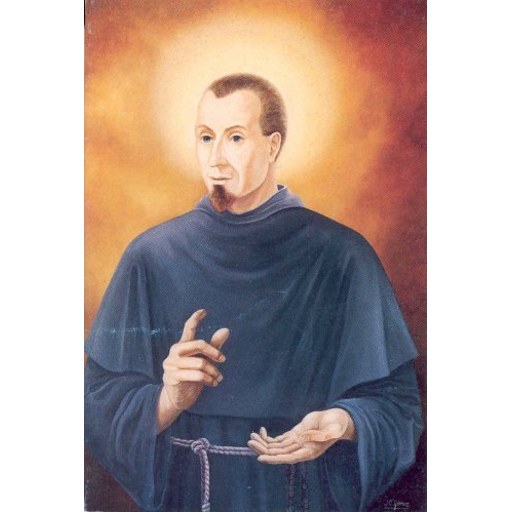
Unknown authorUnknown author
License: Public domain
Francis Fasani
Saint- Life Span
- 1681 - 1742 (age 61)
- Feast Day
- 29 November
- Gender
- male
- Church
- Catholic
Places
Relics & Where to Venerate
Location unknown
The bodily remains of Francis Fasani are a first-class relic. Venerated at Foggia.
Roles & Family
Religious Information
Patronage
Lucera
Canonization
Biography
Francis Anthony Fasani was born Donato Antonio Giovanni Nicola Fasani on 6 August 1681 in Lucera, in the Capitanata region of Apulia, then part of the Kingdom of Naples. He was the son of Giuseppe Fasani and Isabella Della Monaca and was baptized on the day of his birth. Lucera already had a well-established community of Conventual Franciscans, and in 1695, at the age of fourteen, he entered their convent of San Francesco in his native city, receiving the religious name Francesco Antonio.
After the novitiate he completed studies in philosophy and theology in houses of formation of the Order of Friars Minor Conventual in southern Italy. He was ordained a priest in 1705. He later obtained a doctorate in theology and for many years taught philosophy and theology to younger friars, which led his brethren to call him Padre Maestro. His intellectual and pastoral formation was that of an Italian Conventual Franciscan of the early eighteenth century.
Fasani held a series of offices in the Franciscan Province of Sant'Angelo. He served as guardian of the convent in Lucera, as master of novices, and as provincial minister. He was known as a preacher and confessor and devoted much of his energy to the poor, to prisoners, and to the sick of Lucera and the surrounding district. Contemporaries described him as austere in his personal life, given to prayer and penance, and generous in pastoral care. His spirituality emphasized the Eucharist, the Immaculate Conception of the Virgin Mary, and devotion to Saint Joseph.
He spent nearly the whole of his mature ministry in Lucera and died there on 29 November 1742 at the age of sixty-one. A popular cult developed quickly after his death. The cause of beatification was promoted by the Conventual Franciscans and the local church. Pope Pius XII beatified him on 15 April 1951, and Pope John Paul II canonized him on 13 April 1986. His feast is kept on 29 November. He is venerated as a patron of Lucera, and his remains are preserved in the Church of San Francesco in that city.