Francis Solanus is a saint of the Catholic Church (1549 - 1610). Francis Solanus's feast day is celebrated on 14 July. Francis Solanus is the patron saint of Argentina;Bolivia;Chile;Paraguay;Peru;Montilla.
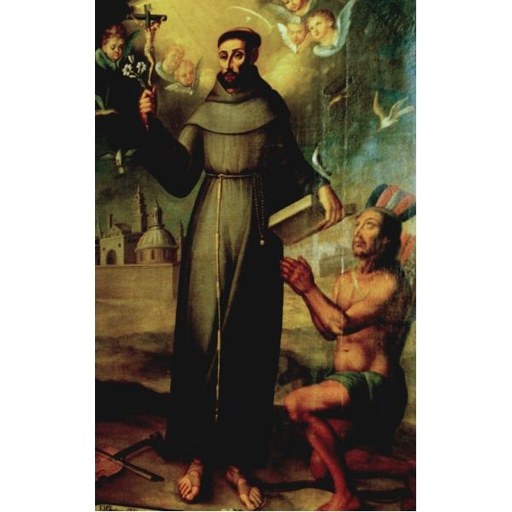
Attributed to Pedro Diaz
License: Public domain
Francis Solanus
Saint- Life Span
- 1549 - 1610 (age 61)
- Feast Day
- 14 July
- Gender
- male
- Church
- Catholic
Places
Roles & Family
Religious Information
Patronage
Argentina;Bolivia;Chile;Paraguay;Peru;Montilla
Canonization
Biography
Francis Solanus (Francisco Sánchez Solano Jiménez) was born on 10 March 1549 in Montilla, in the province of Córdoba in Andalusia, to Mateo Sánchez Solano and Ana Jiménez. He received his early schooling from the Jesuits in his native town. In 1569, at about twenty years of age, he entered the Observant Franciscans at the convent of San Lorenzo in Montilla. After the novitiate and studies in philosophy and theology he was ordained a priest in the mid-1570s. In Spain he served in several houses of the order, including as novice master and as a preacher, and became known for personal austerity and for attending the sick. During plague outbreaks in Andalusia in the 1580s he nursed victims in places such as Montoro, remaining with the dying when others withdrew.
In 1589 he volunteered for the Franciscan missions in the Spanish Americas and sailed from Spain. Contemporary and later accounts of the voyage include a shipwreck in Caribbean waters in which he stayed with enslaved Africans who could not be taken off first, baptizing those who asked. After reaching the mainland he was sent inland to the missions of Tucumán (in present-day northwestern Argentina) and neighboring districts of Paraguay. For some fourteen years he worked among indigenous communities, including Diaguita and related peoples, learning local languages and using music—he played the lute or violin—to gather hearers. He traveled on foot over long distances, lived in poverty, and acquired a reputation as a peacemaker and catechist. Hagiographical tradition later attributed miracles and the gift of tongues to this period; such claims were part of the evidence assembled for his cause but cannot all be independently verified from non-devotional sources.
Recalled from the frontier, he spent his last years in Lima, capital of the Viceroyalty of Peru. There he served as guardian of the Franciscan convent and continued to preach in the city and its surroundings. He died in that convent on 14 July 1610. Crowds sought relics and favors at his death, and a cult developed rapidly in Spanish South America. He was beatified by Pope Clement X in 1675 and canonized by Pope Benedict XIII on 27 December 1726. His liturgical feast is 14 July. He is invoked as patron of Argentina, Bolivia, Chile, Paraguay, and Peru, and of his birthplace, Montilla. His remains are kept at the Basilica and Convent of San Francisco in Lima.