Francisco is a saint of the Catholic Church (1416 - 1507). Francisco's feast day is celebrated on 2 April. Francisco is the patron saint of Calabria;Paola;sailors;mariners;naval officers;Italian Navy;fishermen;boatmen;watermen;travellers;sterile marriages;against fire;against plague.
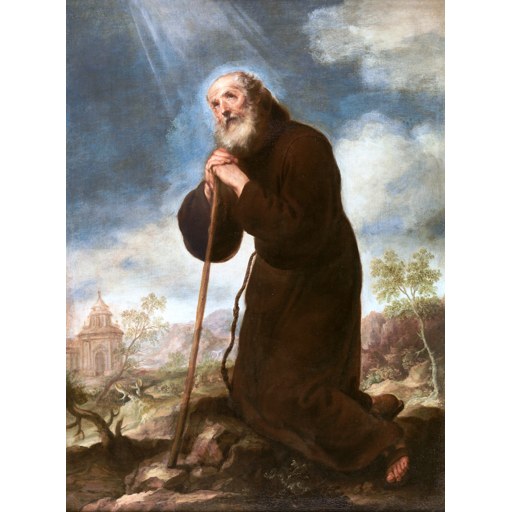
Bartolomé Esteban Murillo
License: Public domain
Francisco
Saint- Life Span
- 1416 - 1507 (age 91)
- Feast Day
- 2 April
- Gender
- male
- Church
- Catholic
Places


Relics & Where to Venerate
Location unknown
The bodily remains of Francisco are a first-class relic. Venerated at Church of the Minims.
Roles & Family
Religious Information
Patronage
Calabria;Paola;sailors;mariners;naval officers;Italian Navy;fishermen;boatmen;watermen;travellers;sterile marriages;against fire;against plague
Canonization
Biography
Francis of Paola, known in Italian as Francesco da Paola, was born in 1416 in the town of Paola in Calabria, then part of the Kingdom of Naples. His parents, Giacomo Martolilla and Vienna da Fuscaldo, had been childless for some years and regarded his birth as an answer to prayers offered through Saint Francis of Assisi; they therefore named the child Francesco. In early childhood he suffered from an affliction of the eye. His parents vowed that if he recovered he would spend a year in a Franciscan house, a vow he later fulfilled as an adolescent in a nearby convent of Friars Minor. After that year he joined his parents on a pilgrimage that took them to Assisi, Rome, and other sanctuaries. The experience confirmed his desire for solitude and penance. Returning to Calabria, he first lived in a hermitage on his father's land and then withdrew to a cave overlooking the sea, where he practiced severe fasting, manual labor, and prayer. He remained a lay religious throughout his life and was never ordained to the priesthood.
Companions soon sought to share his way of life. In the 1430s a small eremitical community took shape near Paola. Francis required of his followers a humility so complete that they styled themselves Minims, the least in the Church. Their rule, developed over subsequent decades and eventually approved by the Holy See, added to the traditional vows a fourth commitment to a perpetual Lenten abstinence from meat and other animal products. The congregation, at first called the Hermits of Saint Francis of Assisi, received papal approval under Pope Sixtus IV in the 1470s and later confirmations that established the Order of Minims as a mendicant order. Houses spread in southern Italy and, after Francis's later years in France, beyond the Alps. The founder governed more by example and spiritual counsel than by juridical office, insisting on charity, humility, and a penitential diet that became the distinctive mark of the Minims.
Reports of miracles, prophecy, and dominion over nature accompanied his reputation for holiness. Tradition holds that when a ferryman refused him passage across the Strait of Messina, Francis spread his cloak on the water and crossed with his companions, an episode that later underpinned his patronage of seafarers. He was credited with healings, the multiplication of food, and knowledge of distant or future events. Italian and foreign princes sought his advice. In the early 1480s King Louis XI of France, hoping to be cured of a mortal illness, used diplomatic and papal pressure to bring Francis to the French court. Francis travelled north reluctantly, arriving in 1483, and took up residence near the royal château of Plessis-lès-Tours. He did not restore the king's bodily health but prepared him for death. Louis XI died that same year. Charles VIII and Louis XII thereafter retained Francis in France, where he founded Minim convents, continued his austere regimen, and served as a spiritual counsellor while remaining detached from court luxury.
Francis died at Plessis-lès-Tours on 2 April 1507. Pope Leo X canonized him on 1 May 1519. His liturgical feast is kept on 2 April. He was buried in the Minim church at Plessis-lès-Tours. In 1562, during the French Wars of Religion, Huguenot soldiers desecrated the tomb and burned most of the body; some relics were rescued and are venerated especially in the basilica at Paola. Francis of Paola is invoked as patron of Calabria and of Paola, of sailors, mariners, naval officers and the Italian Navy, of fishermen and boatmen, of travellers, of couples afflicted by sterility, and against fire and plague. The Order of Minims, though never large, preserved his emphasis on humility and penitential abstinence into the modern period.