Franciszek Nogalski is a servant of god of the Catholic Church (d. 1939).
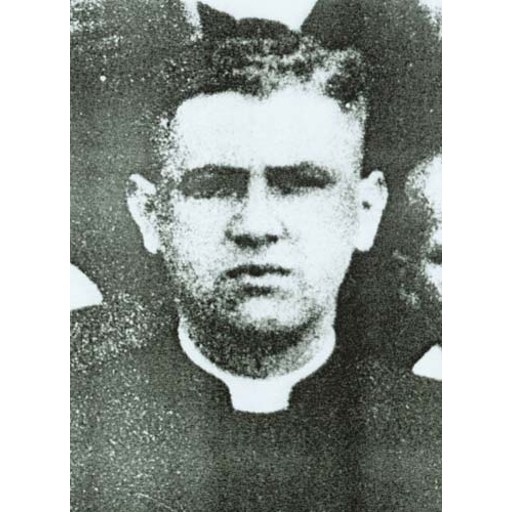
Unknown authorUnknown author
License: Public domain
Franciszek Nogalski
Servant of God- Life Span
- d. 1939
- Gender
- male
- Church
- Catholic
Places
Roles & Family
Biography
Franciszek Nogalski was a Polish Roman Catholic priest of the Latin Rite, a diocesan clergyman rather than a member of a religious congregation, whose name is preserved in the martyrology of Pomerania in the first half of the twentieth century. He belongs to the generation of Polish priests formed in the interwar Second Republic and sent into ordinary parish work in the Kashubian and Pomerelian north. Critical reconstruction of his childhood, the exact place and year of his birth, and the details of his seminary course cannot be offered here with full documentary certainty; what the regional historical and ecclesiastical literature consistently attests is that he served as a vicar in Wejherowo, in the historic Diocese of Chełmno, on the eve of the Second World War.
Wejherowo and the surrounding Kashubian countryside had long been a landscape in which Catholic parish life, Polish language, and local identity were tightly interwoven. After the partitions of Poland the clergy of Pomerelia had often stood as defenders of language and schooling; in the restored Polish state they continued to occupy a visible public role. That visibility made them a designated target when German forces invaded Poland in September 1939 and annexed Pomerelia to the Reich as part of Danzig-West Prussia. Under the Intelligenzaktion, teachers, officials, landowners, and priests were arrested in waves. The Catholic clergy of Wejherowo and neighboring parishes were among those seized in the first months of the occupation.
In the forests near the village of Piaśnica (Wielka Piaśnica), a short distance from Wejherowo, German police and SS units carried out mass shootings from the autumn of 1939 into the following year. The Piaśnica massacre claimed thousands of Polish and Kashubian civilians, patients taken from psychiatric hospitals, and members of the local elite. Franciszek Nogalski is recorded among the priests murdered in those forests in 1939. Victims were typically brought from prisons or collection points, shot at the edge of pits, and buried in mass graves. In 1944, as the Eastern Front receded, the occupiers attempted to obliterate the crime by exhuming and burning bodies, which has left individual identifications and exact dates of death difficult to establish for many of those killed.
After 1945 the Piaśnica forest became a site of Polish national and Catholic memory, marked by monuments, crosses, and annual religious commemorations. Local histories and diocesan martyrologies include Nogalski among the murdered clergy of Wejherowo. He is thus remembered as a victim of a persecution that struck the Church in Pomerania with particular force at the beginning of the occupation. He is not numbered among the 108 Blessed Polish Martyrs of the Second World War who were beatified by Pope John Paul II in 1999, and no feast day or official patronage is attached to his name in the universal or Polish liturgical calendars on the basis of a completed beatification or canonization.
The surviving notice of his life is therefore brief and local rather than that of a widely known saint. He appears as a young parish priest who continued the ordinary ministry of the diocesan clergy until he was swept up in a campaign designed to decapitate Polish society in annexed Pomerania. His memory is kept in the lists of Piaśnica victims, in the remembrance of the Church in Gdańsk and Pelplin, and in the broader Polish recollection of the clergy killed in 1939–1945. A fuller biography would depend on parish archives, seminary records, and the incomplete investigative files of the postwar period; until those are critically assembled, honesty requires that many personal particulars remain unset rather than supplied by conjecture.