François Pallu is a servant of god of the Catholic Church (1626 - 1684).
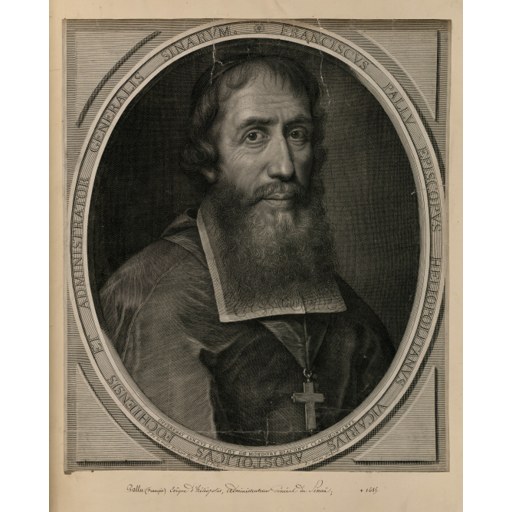
Florent de La Mare-Richart (d'après)
License: Public domain
François Pallu
Servant of God- Life Span
- 1626 - 1684 (age 58)
- Gender
- male
- Church
- Catholic
Places
Roles & Family
Religious Information
Biography
François Pallu was a French Catholic bishop and missionary of the seventeenth century, remembered as one of the founders of the Paris Foreign Missions Society (Société des Missions Étrangères de Paris) and as the first Vicar Apostolic of Tonkin. He was born in 1626 in Tours, in west-central France. He entered the clerical state, completed studies for the priesthood, and was ordained. In the 1650s he joined a group of French priests who, encouraged by the reports of the Jesuit Alexandre de Rhodes and by the Congregation for the Propagation of the Faith, sought to send secular clergy to East Asia. Their purpose was to erect apostolic vicariates independent of the Portuguese padroado and to form a native clergy. That project led to the foundation of what became the Paris Foreign Missions Society and to the opening of a seminary in Paris for missionary priests.
In 1658 Pope Alexander VII named Pallu Vicar Apostolic of Tonkin, with the titular see of Heliopolis in Augustamnica. Pierre Lambert de la Motte was appointed to Cochinchina, and Ignace Cotolendi received a vicariate covering parts of China. Pallu received episcopal consecration before leaving for the East. He departed Europe around 1660 and traveled through the Levant, Persia, and India. He reached the kingdom of Siam and its capital Ayutthaya in the early 1660s. Portuguese resistance, warfare in Vietnam, and the hazards of the route prevented him from settling in Tonkin. Working from Siam with Lambert de la Motte, he helped organize missions in the region, encouraged the training of local catechists and priests, and supported the establishment of a general seminary at Ayutthaya, which served candidates from several Asian countries.
Pallu returned to Europe more than once to obtain papal confirmation of the vicars’ authority, to contest padroado claims, and to secure French royal and financial support. During a voyage in the 1670s he was detained by Spanish colonial authorities in the Philippines and sent to Spain; after his release he continued his advocacy in Rome and in France. In the early 1680s the Holy See adjusted missionary boundaries in East Asia, and Pallu’s responsibilities were extended toward China, including areas of Fujian. He reached the Chinese coast in 1684 and died the same year at Muyang in Fujian province. He thus ended his life in China without having exercised residential ministry in the Tonkin vicariate for which he had first been appointed.
Pallu’s importance lies less in long years of local pastoral work than in the institutional framework he helped to create. Together with Lambert de la Motte and the early members of the Paris Foreign Missions Society, he advanced a model of mission based on apostolic vicars appointed by Rome, secular missionary priests, and the formation of indigenous clergy. That model stood in tension with the older Iberian patronage system and with some religious orders already present in Asia. He was neither beatified nor canonized, and he has no universal feast day. Historians of the Catholic missions in Vietnam, Siam, and China treat him as a principal organizer of the mid-seventeenth-century French missionary enterprise in Asia.