Franjo Kuharić is a servant of god of the Catholic Church (1919 - 2002).
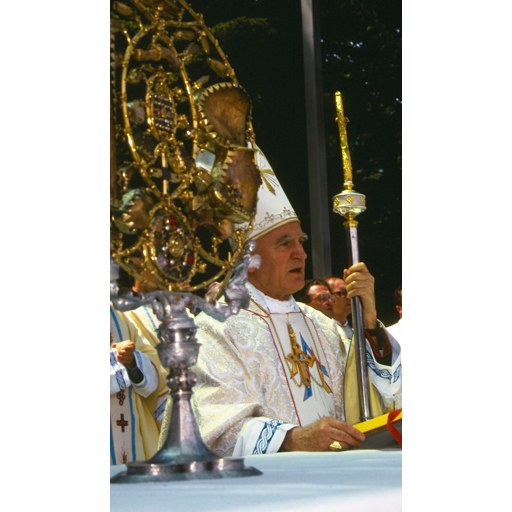
Goran Moravček
License: CC BY-SA 3.0
Franjo Kuharić
Servant of God- Life Span
- 1919 - 2002 (age 83)
- Gender
- male
- Church
- Catholic
Places
Relics & Where to Venerate
Location unknown
The bodily remains of Franjo Kuharić are a first-class relic. Venerated at Zagreb Cathedral.
Roles & Family
Biography
Franjo Kuharić was born on 15 April 1919 in the village of Pribić in the Croatian Zagorje, then within the Kingdom of Serbs, Croats and Slovenes. He grew up in a rural Catholic family and received his priestly formation at the archdiocesan seminary and the Catholic Faculty of Theology in Zagreb. On 15 July 1945 he was ordained a priest by Archbishop Alojzije Stepinac, only weeks after the end of the Second World War in Europe. The new communist authorities in Yugoslavia soon imposed harsh controls on the Church; Stepinac was arrested in 1946 and later confined. Kuharić’s early priesthood therefore unfolded under a regime that restricted religious education, confiscated Church property, and monitored the clergy. He served in parish ministry in the Archdiocese of Zagreb, gaining a reputation as a dedicated pastor.
Pope Paul VI named him auxiliary bishop of Zagreb in 1964, and he was consecrated bishop on 3 May 1964. After Cardinal Franjo Šeper was appointed Prefect of the Congregation for the Doctrine of the Faith in Rome, Kuharić assumed leadership of the archdiocese and was appointed Archbishop of Zagreb in 1970. He remained in that office until 1997, making him one of the longest-serving modern archbishops of the Croatian capital. Throughout the 1970s and 1980s he worked to sustain Catholic life under late Yugoslav communism: defending the right to religious instruction, supporting vocations, and keeping public memory of Cardinal Stepinac alive at a time when the state still treated Stepinac as a controversial figure. In the consistory of 2 February 1983, Pope John Paul II created him cardinal, with the titular church of San Girolamo dei Croati in Rome, a church long associated with the Croatian nation.
The collapse of Yugoslavia and the Croatian War of Independence in the early 1990s defined the later years of his episcopate. As the senior Catholic hierarch in Croatia, Cardinal Kuharić spoke frequently against the killing of civilians, the destruction of churches and villages, and the expulsion of populations. He affirmed the Croatian people’s right to an independent state while insisting that independence must not be built on hatred or revenge. He visited the wounded and displaced and urged priests to remain with their people. In 1994 he welcomed Pope John Paul II on the first papal visit to Croatia, an event of great symbolic importance after decades of communist isolation. Kuharić also presided over the transition of the bishops’ conference from a Yugoslav to a Croatian institution.
He resigned the governance of the Archdiocese of Zagreb in 1997 and was succeeded by Josip Bozanić. Cardinal Kuharić died in Zagreb on 11 March 2002 and was buried in Zagreb Cathedral, the historic seat of the archbishops. He is remembered in Croatia as a spiritual leader who accompanied the nation through dictatorship, war, and the first years of sovereignty. Devotion to his memory later led to the opening of a cause for beatification, but he has not been beatified or canonized by the Catholic Church.