Franz-Josef Rudigier is a venerable of the Catholic Church (1811 - 1884).
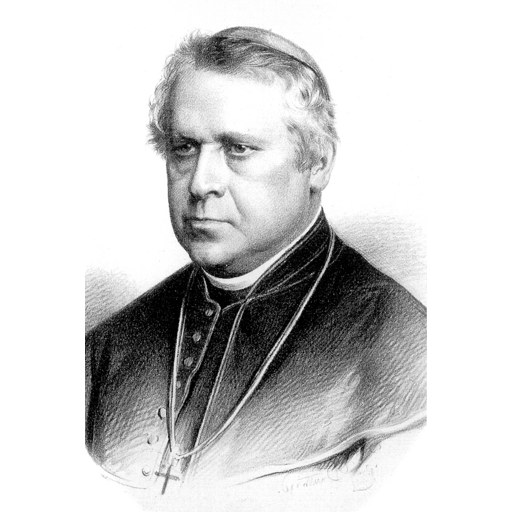
Unknown authorUnknown author
License: Public domain
Franz-Josef Rudigier
Venerable- Life Span
- 1811 - 1884 (age 73)
- Gender
- male
- Church
- Catholic
Places
Roles & Family
Biography
Franz Josef Rudigier was born on 7 April 1811 in Partenen, a village in the Montafon valley of Vorarlberg, then part of the Austrian Empire. He came from modest rural Alpine circumstances and was educated for the priesthood within the Diocese of Brixen, which at that period included Vorarlberg as well as Tyrol. He was ordained a priest in 1835. After early pastoral assignments he joined the seminary at Brixen as a professor, teaching pastoral theology, church history, and canon law, and later serving as rector. Those years formed him as a restorationist, Rome-oriented cleric typical of much of the mid-nineteenth-century Austrian church, before the imperial court and the Holy See called him to the episcopate.
Nominated by Emperor Franz Joseph I in 1852 and confirmed by Pope Pius IX, Rudigier became Bishop of Linz in 1853 and governed that Upper Austrian see until his death more than three decades later. He set out to reverse the lingering effects of Josephinist state-church policy by strengthening papal and episcopal authority, inviting religious congregations, fostering Catholic associations and schools, and supporting a diocesan Catholic press. His most visible undertaking was the New Cathedral in Linz, the Cathedral of the Immaculate Conception (Mariendom), planned as a votive church after the 1854 definition of the Immaculate Conception. The foundation stone was laid in 1862. The vast neo-Gothic building, intended as one of the great churches of the Habsburg lands, was unfinished when he died and was completed only in the twentieth century.
Rudigier was a leading ultramontane in the Austrian half of the monarchy. He defended the Concordat of 1855 and opposed the liberal legislation of the late 1860s that curtailed the Church’s role in marriage and education. A pastoral letter of 1868 attacking those so-called May Laws led to his prosecution; in 1869 a court in Linz sentenced him to fourteen days’ imprisonment for disturbing public order. The case became a Catholic cause célèbre. Emperor Franz Joseph pardoned him, and he did not serve the sentence, but the conflict fixed his public image as a bishop prepared to confront the liberal state. By office he also sat in the Austrian Herrenhaus, where he spoke for ecclesiastical interests.
He died in Linz on 29 November 1884 and was buried in the cathedral whose construction he had begun. In the Diocese of Linz he is remembered as the principal nineteenth-century organizer of Catholic life in Upper Austria and as a symbol of resistance to Josephinism and liberalism. He has not been beatified or canonized.