Franz Regis Clet is a blessed of the Catholic Church (1748 - 1820). Franz Regis Clet's feast day is celebrated on 18 February.
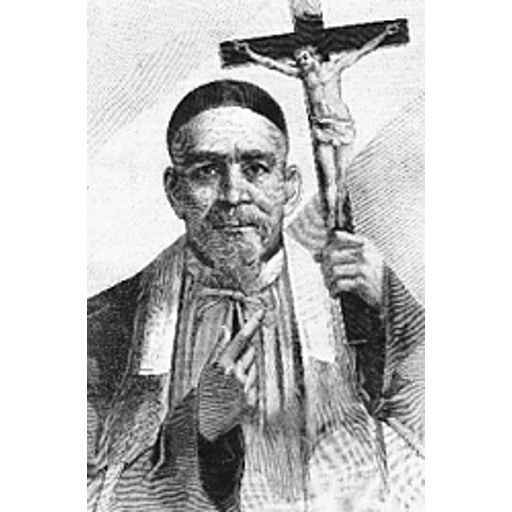
Unknown. Anonyme.
License: Public domain
Franz Regis Clet
Blessed- Life Span
- 1748 - 1820 (age 72)
- Feast Day
- 18 February
- Gender
- male
- Church
- Catholic
Places
Roles & Family
Religious Information
Canonization
Biography
François-Régis Clet was born in 1748 in Grenoble, in southeastern France, into a large and devout Catholic family of the local merchant class. He received the names of the Jesuit missionary saint Jean-François Régis, a choice that reflected the religious culture of the Dauphiné. After studies in his native city he entered the Congregation of the Mission—the Vincentians, also called Lazarists—in 1769. He was ordained to the priesthood in 1773. For the following years he served the congregation in France, teaching moral theology at the seminary of Annecy and later directing the internal seminary in Paris, where he formed Vincentian novices. By the time the Revolution broke upon the French Church he was already a mature priest of established reputation within his community rather than a young volunteer for distant missions.
The French Revolution suppressed religious houses and imposed the Civil Constitution of the Clergy, which shattered the ordinary work of the Congregation of the Mission in France. In 1791 Clet asked to be sent abroad and was assigned to China, where the Vincentians had taken on pastoral responsibility for territories once served by the Jesuits. He left Europe in middle age, reached Macau, and then traveled inland. From the early 1790s until his death he lived as an underground missionary in central China, chiefly in Jiangxi and Hubei, serving scattered Catholic communities that had little regular access to priests. He remained on that mission for nearly three decades, through changing degrees of official tolerance and hostility under the Qing dynasty.
Life on the mission was severe. Clet lived in poverty, moved often to avoid detection, and, according to his letters and later Vincentian biographers, never gained full fluency in Chinese, which limited his preaching even as he persevered in the sacraments, the instruction of catechumens, and the support of local catechists. Edicts against the “religion of the Lord of Heaven” were enforced with varying intensity. For long stretches he worked almost alone over a wide rural territory, depending on Christian families for shelter and sharing the insecurity of converts who could be denounced at any time.
In 1819 a renewed campaign against Christians led to his betrayal and arrest. He was moved from one yamen prison to another, interrogated, and beaten, and was finally condemned to death. On 18 February 1820, at Wuchang in Hubei, he was executed by strangulation, the method attached to his sentence. He was seventy-one years old. News of the execution reached Europe through missionary correspondence and was received by the Congregation of the Mission as the death of a martyr.
The Holy See examined his cause in the nineteenth century. Pope Leo XIII beatified him in 1900. On 1 October 2000 Pope John Paul II canonized him together with 119 other martyrs of China, a group that includes both foreign missionaries and Chinese lay faithful, clergy, and religious killed between the seventeenth and twentieth centuries. In the General Roman Calendar that group is celebrated on 9 July; Clet is also remembered on 18 February, the anniversary of his death. The Congregation of the Mission venerates him as a model of perseverance on a difficult mission and as one of its principal martyrs in China.