Frederick of Utrecht is a saint of the Catholic Church (d. 838). Frederick of Utrecht's feast day is celebrated on 18 July. Frederick of Utrecht is the patron saint of Utrecht.
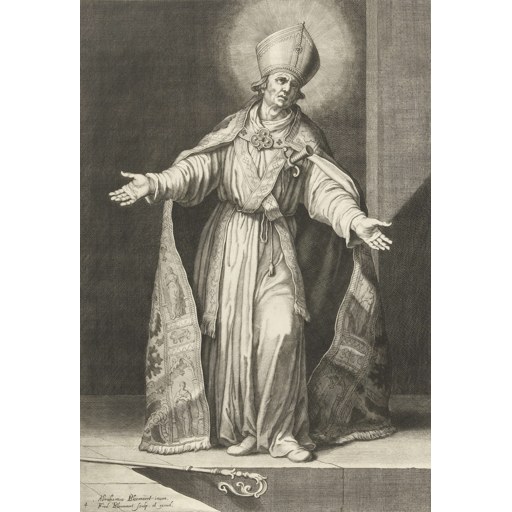
Frederick Bloemaert naar een schilderij van Abraham Bloemaert
License: Public domain
Frederick of Utrecht
Saint- Life Span
- d. 838
- Feast Day
- 18 July
- Gender
- male
- Church
- Catholic
Places
Relics & Where to Venerate
Location unknown
The bodily remains of Frederick of Utrecht are a first-class relic. Venerated at Utrecht.
Roles & Family
Patronage
Utrecht
Biography
Frederick of Utrecht (Latin Fridericus; Dutch Frederik van Utrecht) was a ninth-century bishop of Utrecht, remembered as a martyr and venerated in the Catholic Church. Almost nothing about him can be established from strictly contemporary records; the narrative of his life depends on later medieval hagiography, especially an eleventh-century vita, together with the liturgical tradition of the church of Utrecht. He is described as a Frisian of noble birth. A subsequent genealogical legend that made him a grandson of the Frisian king Radbod is not supported by early evidence and is treated as unhistorical. No reliable source gives a precise year or place of birth. He was educated at the cathedral school of Utrecht under Bishop Ricfried, ordained to the priesthood, and chosen to succeed Ricfried as bishop, most probably in the mid-810s, during the reign of the emperor Louis the Pious.
As bishop he worked to consolidate Christianity in Frisia, a frontier region only recently and incompletely converted, and to enforce canonical discipline among clergy and laity. Tradition stresses his preaching against incest and other irregular marriages among the aristocracy, and his encouragement of missionary work in still-pagan coastal districts, including Walcheren and related islands of Zeeland. Hagiographers also claimed that he publicly rebuked Empress Judith of Bavaria for alleged immorality. Modern historians regard that court episode as doubtful and possibly a later embroidery meant to supply a political motive for his death. He belonged to the secular clergy of the see rather than to a monastic order.
According to the received tradition he was attacked and fatally wounded on 18 July 838 after celebrating Mass in the church of Saint Salvator (the Oudmunster) at Utrecht. The assassins are identified in the legends variously as hired killers, as kinsmen of persons he had rebuked, or as pagans from Walcheren. He died of his wounds and was buried in the same church. Whatever the precise motive—local vengeance, resistance to his moral preaching, or residual pagan hostility—his death was remembered as martyrdom. The year 838 is the date given by the standard tradition and by most modern reference works, though the episcopal chronology of Utrecht in this period is not free of uncertainties, and some older lists placed the end of his episcopate a few years earlier.
A cult developed at Utrecht, and his feast is kept on 18 July. He is one of the many early medieval saints whose veneration arose locally and was never the object of a formal papal canonization of the later medieval or Tridentine type; he is therefore counted among the so-called pre-congregation saints. Relics associated with him were preserved at Saint Salvator. His securely attested standing is that of a diocesan saint and martyr of Utrecht; later popular lists sometimes add further patronages, but those attributions are not well grounded in early sources. Historically he belongs to the Carolingian Christianization of the northern Low Countries and to the memory of episcopal martyrdom on the Frisian frontier.