Friedrich von Regensburg is a blessed of the Catholic Church (d. 1329). Friedrich von Regensburg's feast day is celebrated on 30 November.
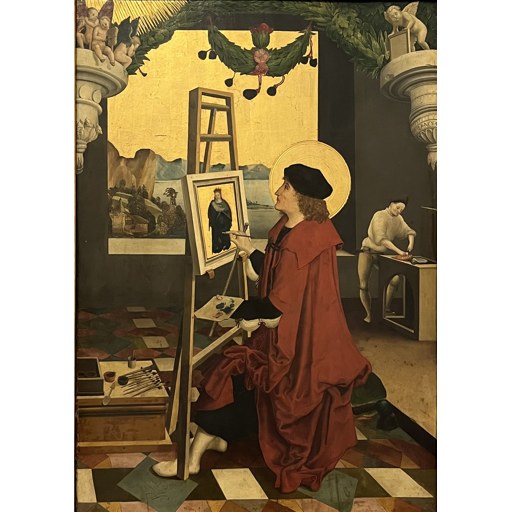
https://en.wikipedia.org/wiki/Saint_Luke_painting_the_Virgin
License: unknown
Friedrich von Regensburg
Blessed- Life Span
- d. 1329
- Feast Day
- 30 November
- Gender
- male
- Church
- Catholic
Places
Roles & Family
Religious Information
Canonization
Biography
Blessed Friedrich von Regensburg, known in English as Frederick of Ratisbon, was a German Augustinian lay brother of the thirteenth and fourteenth centuries. He was born in Regensburg, a free imperial city on the Danube in Bavaria, then part of the Holy Roman Empire. No reliable source records the year of his birth. He entered the local monastery of the Order of Hermits of Saint Augustine (the order that had been unified by papal bull in 1256) as a converse, or lay brother, thereby committing himself to a life of manual work and simple prayer rather than to the priesthood or the choir office.
In the monastery Friedrich labored as a carpenter and general craftsman. Later Augustinian writers describe him as outstanding in humility, obedience, and recollection. He is said to have spoken little, to have accepted the lowliest tasks without complaint, and to have spent whatever free time he had in prayer before the Blessed Sacrament. These traits, together with a reputation for miracles after his death, formed the basis of his local cult.
A characteristic episode in the legendarium tells that, while Friedrich was working away from the church and therefore missed Mass, an angel appeared and gave him Holy Communion. Whether the story preserves a historical kernel or is a conventional hagiographical motif cannot be established; the earliest written accounts of his life date from well after his death. What the tradition does attest is the centrality of Eucharistic devotion in the memory that the community preserved of him.
Friedrich died on 30 November 1329 inside the Regensburg convent and was buried in its church. Pilgrims soon began to visit the tomb, and healings were attributed to his intercession. The cult remained confined to the city and the Augustinian order until the early twentieth century, when Pope Pius X confirmed the longstanding public veneration and enrolled Friedrich among the blesseds. His memorial is celebrated on 30 November. Surviving documentation is extremely limited; the historian must therefore treat the figure of Friedrich von Regensburg as an example of late-medieval lay-brother sanctity whose outline is known only through later pious tradition rather than through contemporary records.