Frodulphe de Barjon is a saint of the Catholic Church. Frodulphe de Barjon's feast day is celebrated on 8 September. Frodulphe de Barjon is the patron saint of Barjon.
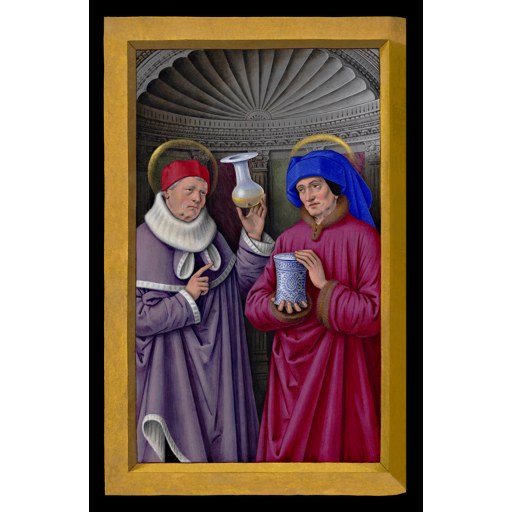
https://commons.wikimedia.org/wiki/Commons:Valued_images_by_topic/Works_of_art/Paintings_and_pictorial_arts
License: unknown
Frodulphe de Barjon
Saint- Feast Day
- 8 September
- Gender
- male
- Church
- Catholic
Places
Relics & Where to Venerate
Location unknown
Bones of his body are preserved in a reliquary of gilded wood in the parish church of Saint-Philibert in Trouhaut (Côte-d'Or) == Legacy == Saint Frou is invoked against headaches and toothaches
Roles & Family
Religious Information
Patronage
Barjon
Biography
Frodulphe de Barjon, also known as Frodulphus, was a Frankish monk and hermit of Burgundy in the later Merovingian age, remembered in local Catholic tradition as a disciple of Saint Léger (Leodegar) of Autun. The surviving notices place his birth at Autun (the ancient Augustodunum) in the seventh century, though no contemporary record gives a year. He entered the monastery of Saint-Martin at Autun, a house founded in the late sixth century, and later tradition styles him abbot of that community. His formation and public identity are bound up with Léger, bishop of Autun from the 660s until 678, a prelate whose episcopate combined pastoral government with dangerous involvement in the factional politics of Neustria, Austrasia, and Burgundy.
Léger’s fall determined Frodulphe’s later life. After conflict with Ebroin, the Neustrian mayor of the palace, Léger was deposed, blinded, imprisoned, and finally put to death in 678. In the persecution that followed, Frodulphe is said to have left Autun. Hagiographical memory presents the departure both as flight from political danger and as a turn to a hidden religious life. He withdrew into the countryside of what is now the Côte-d’Or and settled at Barjon, then a modest rural site in the Burgundian church. There he lived as a hermit. Later piety associated Barjon with his solitude, his example, and his death; a local cult grew around his tomb, and the village came to regard him as its saint.
No strictly contemporary source records the day or year of his death. Later liturgical and diocesan notices commonly place it around the middle of the eighth century, often given approximately as about 750, but that figure is conventional rather than demonstrated. He died at Barjon and was buried there. The historical dossier is thin: no early independent vita survives that would allow a detailed reconstruction of his career, and what is known rests on local commemoration, brief later martyrological entries, and the memory of the Autun–Barjon tradition. Relics remained associated with the church of Barjon, which preserved his cult when written documentation did not.
In the Catholic Church he is venerated as a saint, with a feast observed on 8 September in the French tradition linked to Autun and Barjon. He was not the object of a formal papal canonization of the later medieval or modern type; his cult belongs to the pre-congregation era, in which holiness was recognized by local churches. The sources consistently present him as a monk and hermit, not as a married man or a father. Beyond Barjon itself, no wider list of patronages is securely attested. Modern historians treat him as a plausible figure of Burgundian monasticism in the generation after Léger’s martyrdom, while remaining cautious about legendary accretions that often surround local holy men of the Merovingian period.