Gaspar de Bono is a blessed of the Catholic Church (1530 - 1604). Gaspar de Bono's feast day is celebrated on 14 July.
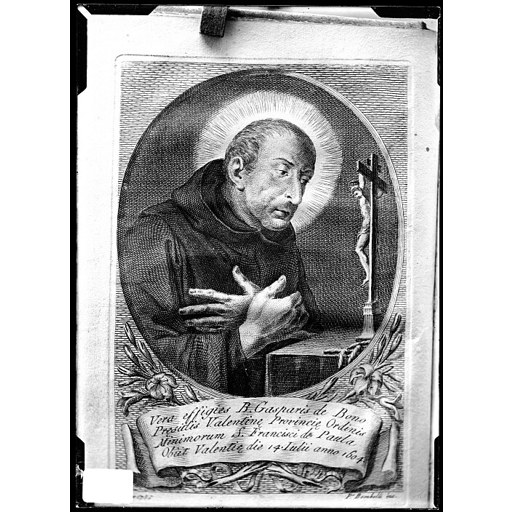
Pietro Leone Bombelli
License: Public domain
Gaspar de Bono
Blessed- Life Span
- 1530 - 1604 (age 74)
- Feast Day
- 14 July
- Gender
- male
- Church
- Catholic
Places
Relics & Where to Venerate
Location unknown
The bodily remains of Gaspar de Bono are a first-class relic. Venerated at Valencia.
Location unknown
After the suppression of the monastery under the Napoleonic rule of Spain, the urn containing his bones was moved in 1835 to the Church of San Nicolás, where he had been baptized as a baby, and enshrined under the altar of the Chapel of St
Location unknown
After the suppression of the monastery under the Napoleonic rule of Spain, the urn containing his bones was moved in 1835 to the Church of San Nicolás, where he had been baptized as a baby, and enshrined under the altar of the Chapel of St
Roles & Family
Religious Information
Canonization
Biography
Gaspar de Bono was born in Valencia, then part of the Spanish Habsburg monarchy, on 5 January 1530. His father, Juan de Bono (also given as Giovanni Bono), was a merchant of Genoese origin who had settled in the city; his mother was Isabel Navarro. The household belonged to the artisan and commercial classes tied to Valencia’s silk trade. Little independent documentation survives of his childhood. As a young man he entered military service in the armies of Charles V and later Philip II, a common path for Valencian men of his station in the mid-sixteenth century. Later hagiographical accounts, assembled for his beatification, relate that he was gravely wounded in campaign—sometimes associated in tradition with the wars of the 1550s—and that the experience of recovery led him to abandon arms for religious life. Precise details of his military career remain sparsely attested outside those later narratives.
After leaving the army he returned to Valencia and sought admission to the Order of Minims, the mendicant congregation founded by Francis of Paola and distinguished by a fourth solemn vow of perpetual Lent, which forbade meat, eggs, and dairy. He entered the Minim community in Valencia in the early 1560s, completed the novitiate, made profession, and was ordained a priest. Within the Spanish houses of the order he became known for strict observance, personal humility, and charity toward the poor and the sick. He was given offices of government, serving as local superior and eventually as provincial of the Minims in Spain, which required him to visit convents and uphold the rule across the province.
He spent his later decades chiefly in Valencia, combining administration with preaching and the direction of souls. Witnesses in the beatification processes described him as a man of continual prayer who remained accessible to penitents of every class. Popular devotion credited him with reconciliations and favors, claims that belong to the hagiographical tradition rather than to strictly contemporary chronicle. He died in Valencia on 14 July 1604, at about seventy-four years of age, and was buried in the church of his order in that city.
A local cult formed after his death. The cause of beatification was introduced at Rome, and Pope Pius VI declared him blessed in 1786. His liturgical commemoration is kept on 14 July, the anniversary of his death. He has not been canonized. Surviving evidence for his life is modest and is largely filtered through the acts of beatification; modern historians therefore treat some of the more picturesque episodes of his military youth and of reported miracles with caution, while accepting the main outline of his career as a Minim priest and provincial in sixteenth-century Spain.