Gaudericus de Vilavella is a saint of the Catholic Church. Gaudericus de Vilavella's feast day is celebrated on 16 October. Gaudericus de Vilavella is the patron saint of farmers;peasants;agriculture;harvests;rain;Roussillon.
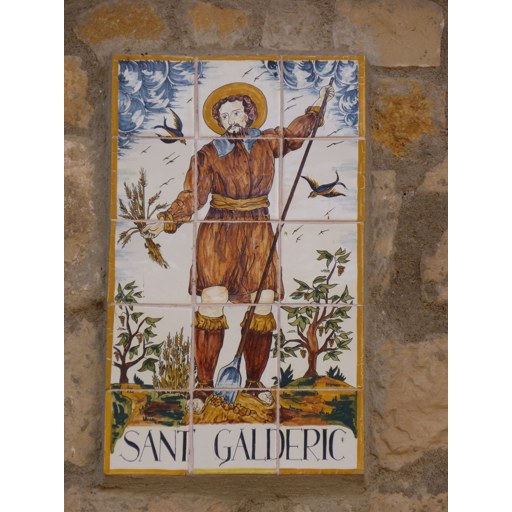
Bestiasonica
License: CC BY 3.0
Gaudericus de Vilavella
Saint- Feast Day
- 16 October
- Gender
- male
- Church
- Catholic
Places
Roles & Family
Patronage
farmers;peasants;agriculture;harvests;rain;Roussillon
Biography
Gaudericus de Vilavella, known in Catalan as Sant Galdric and in French as Saint Gaudérique, is a ninth-century rural saint associated with the vanished village of Vilavella (Latin Villa Vetula) in historic Roussillon, in the eastern Pyrenees. The site is generally placed in what is now the French département of Pyrénées-Orientales, in territory that in his lifetime formed part of the Carolingian Spanish March and the County of Roussillon. No contemporary charter, chronicle, or liturgical notice of his life survives. Everything that is repeated about him comes from later medieval and early modern local tradition, diocesan calendars, and popular hagiography, and must be treated as legendary in character rather than as documented biography. Even the identification of Vilavella itself is not settled with precision; the village disappeared, and later writers have proposed more than one location in Roussillon, Capcir, or Cerdagne.
In the received story he was a lay ploughman, not a monk or cleric. Tradition describes a life of agricultural labour joined to prayer, fasting, and charity toward the poor. He is remembered as a model of rural piety rather than as a preacher, founder, or miracle-worker during his lifetime. No reliable source records whether he married or had children. He is said to have died on 16 October, the date that became his feast; the year is conventionally given in later compilations as around 900, but that figure is traditional and round, not anchored in a contemporary record. He was buried at Vilavella, and the tomb became the first centre of a local cult among peasants who invoked him for rain, the protection of crops, and a successful harvest.
Devotion to Gaudericus spread through Roussillon and neighbouring Catalan-speaking districts. Relics attributed to him were translated in later centuries; places connected with the cult include the abbey of Saint-Martin-du-Canigou and, from the early modern period, churches in Perpignan, notably Saint-Jacques, as well as the diocese of Elne (later Perpignan-Elne). He became the principal patron of farmers and peasants in Roussillon. Iconography typically shows him as a labourer with a goad, plough, or oxen. Blessings of the fields and processions on or near 16 October remained part of local custom into the modern era. He was not the subject of a formal papal canonization of the later medieval or Tridentine type; his saintly status rests on immemorial diocesan cultus rather than on a named Roman process.
Historical scholarship therefore classifies Gaudericus among the early medieval popular saints of the Pyrenean countryside, whose memory was preserved by agrarian religion and later liturgical recognition rather than by monastic vitae written close to the events. The biographical outline is thin and late, but the cult itself is well attested in the religious geography of Roussillon and remains the chief reason he is remembered.