Gaudiosus of Tarazona is a saint of the Catholic Church (d. 540). Gaudiosus of Tarazona's feast day is celebrated on 3 November.
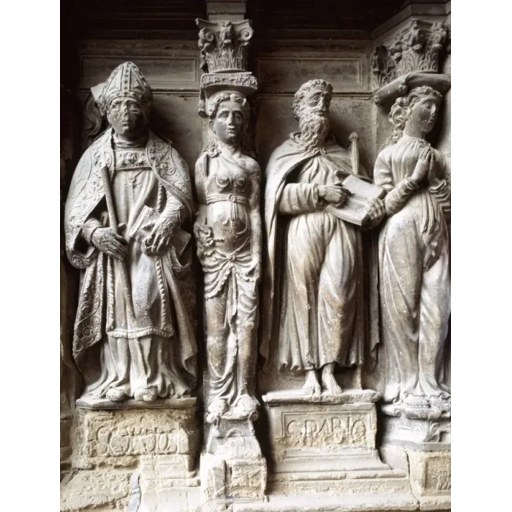
https://prints-online.com/portal-sculptures-tarazona-cathedral-aragon-14319612.html
License: unknown
Gaudiosus of Tarazona
Saint- Life Span
- d. 540
- Feast Day
- 3 November
- Gender
- male
- Church
- Catholic
Places
Relics & Where to Venerate
Housed at Tarazona Cathedral · Spain
In 1573 his remains were disinterred and translated to the cathedral of Tarazona
Roles & Family
Biography
Gaudiosus of Tarazona, known in Spanish as San Gaudioso, was a bishop of the see of Tarazona (ancient Turiaso or Turiasso) in the Ebro valley of northeastern Hispania during the Visigothic period of the sixth century. Almost nothing about his life can be established from contemporary documentation. No acts of sixth-century councils list him with certainty, and no chronicle of the Visigothic kingdom supplies a biography. The narrative details that circulate in later centuries derive principally from a vita composed in the sixteenth century, a text written a millennium after the bishop’s lifetime and therefore of limited value as historical evidence. What remains reasonably secure is that a bishop named Gaudiosus occupied the chair of Tarazona and that a local cult grew up around his memory, leading to his veneration as a saint within the diocese.
According to that late hagiographic tradition, Gaudiosus was a native of Escorón, a small place in the district of Tarazona in what is now the province of Zaragoza in Aragon. He is said to have embraced monastic life at San Martín de Asán, a monastery in the Pyrenean region associated with Saint Victorian of Asan, who appears in the story as Gaudiosus’s abbot and teacher. After years in the cloister he was chosen bishop of Tarazona. Tradition places his death around the year 540. These particulars—birth at Escorón, profession under Victorian, and the approximate year of death—cannot be confirmed from any source close to the sixth century, and historians treat them as pious legend rather than established fact.
The bishopric of Tarazona was already an old foundation by Gaudiosus’s time, with roots in the late Roman organization of Hispania Tarraconensis. In the sixth century the city lay within the Visigothic kingdom, whose rulers were still largely Arian at the beginning of the century and whose conversion to Nicene Christianity was completed later under King Reccared. A Catholic bishop of Tarazona in this period would have ministered to a Hispano-Roman and converting Gothic population in a frontier zone of the Ebro valley. Beyond that general setting, no sermons, letters, or conciliar signatures survive that can be attributed to Gaudiosus himself. He should not be confused with other holy men of the same name, notably Gaudiosus of Naples, a North African bishop who fled the Vandal persecution and settled in Campania in the fifth century.
Devotion to Gaudiosus remained essentially local. He is commemorated on 3 November in the calendar of the Diocese of Tarazona. Relics associated with him were kept in the city, and a church was dedicated under his name. He was never Bishop of Rome nor patriarch of any Eastern see. There is no historical record of a wife or of children; the monastic origin ascribed to him in the later vita implies a celibate life, which is also the usual presentation of an early medieval bishop-saint. He was not the subject of a formal papal canonization of the later medieval type; like most saints of late antiquity and the early Middle Ages, he was recognized through popular and diocesan cultus. The principal patron of Tarazona in later centuries was Saint Atilanus, a tenth-century bishop of the same see, and Gaudiosus does not appear to have accumulated a wide range of specialized patronages.
Modern scholarship therefore regards Gaudiosus of Tarazona as an obscure sixth-century prelate whose existence and episcopal office are accepted, but whose personal history is known only through a late and uncritical legend. The caution required of the historian is not a denial of his sanctity in the eyes of the local church, but a recognition that the surviving dossier does not permit a detailed or confidently dated biography.