Gayané is a saint of the Catholic Church (d. 301). Gayané's feast day is celebrated on 1 June (Armenian Apostolic Church); 29 September (Roman Martyrology).
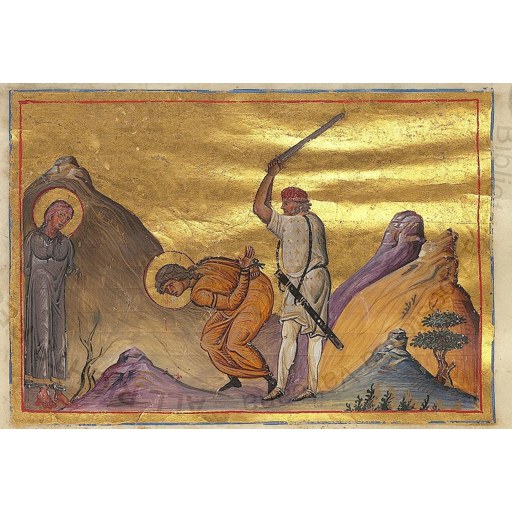
Authors of Menologion of Basil II (circa 985 AC, Constantinople), Byzantine manuscript illuminators[1]: Pantoleon with Georgios, Michael the Younger, Michael of Blachernae, Symeon, Symeon of Blachernae, Menas, and Nestor (Online on Vatican site)
License: Public domain
Gayané
Saint- Life Span
- d. 301
- Feast Day
- 1 June (Armenian Apostolic Church); 29 September (Roman Martyrology)
- Gender
- female
- Church
- Catholic
Places
Roles & Family
Biography
Saint Gayane (also rendered Gaiane, Gaiana, or Gayaneh) is an early fourth-century Christian abbess and martyr, known almost exclusively from Armenian hagiographical tradition. The principal narrative source is the History of the Armenians attributed to Agathangelos, a work of the fifth century that became foundational for the Armenian Church’s account of the nation’s conversion. According to that tradition, Gayane was the superior of a community of consecrated virgins in the Roman Empire, commonly identified with Rome. Among her nuns was Hripsime (Rhipsime), a woman of notable beauty. When the Roman emperor—identified in the legend with Diocletian—sought Hripsime in marriage, the community fled in order to preserve their vows of chastity. After a period of wandering they reached the Kingdom of Armenia and settled near the royal city of Vagharshapat.
King Tiridates III of Armenia, having heard of Hripsime’s beauty, likewise demanded her as his wife. She refused, declaring herself consecrated to Christ. Gayane, as abbess, exhorted her spiritual daughters to remain steadfast. Enraged, the king ordered the nuns seized and put to death. Hripsime was subjected to prolonged torture and killed; Gayane was then tortured—later accounts mention beating, the cutting out of her tongue, and stoning or beheading—and martyred together with some thirty companions. Armenian ecclesiastical tradition dates these events to the year 301, immediately before the conversion of Tiridates. Independent corroboration of the precise year, of Gayane’s birthplace, and of the Roman origin of the community does not survive outside this hagiographical cycle; the story as received is that of Agathangelos and of subsequent Armenian liturgy and art.
The martyrdom occupies a central place in the Armenian conversion narrative. After the slaughter of the nuns, Tiridates is said to have been stricken with madness, from which he recovered only when Saint Gregory the Illuminator, released from imprisonment in the pit of Khor Virap, preached the Gospel and baptized the king and the court. Armenia thus became, in church tradition, the first kingdom to adopt Christianity as its state religion. The tombs of the martyrs became sites of pilgrimage. In 630 Catholicos Ezra I built the Church of Saint Gayane over Gayane’s burial place in Vagharshapat (Etchmiadzin). The seventh-century church remains a cathedral of the Armenian Apostolic Church and forms part of the UNESCO-listed Etchmiadzin ensemble.
Gayane is commemorated with Hripsime and their companions as proto-martyrs of the Armenian Church. In the Armenian Apostolic calendar her feast is associated with 1 June (in close connection with the feast of Hripsime); the Roman Martyrology lists Rhipsime, Gaiana, and companions on 29 September. She is invoked as a model of monastic fidelity and courage under persecution. Relics associated with her rest in the Church of Saint Gayane. Beyond the Agathangelos tradition and the continuous cult at Vagharshapat, details of her early life, the exact constitution of her community, and the historical kernel of the flight from Rome cannot be verified from contemporary non-hagiographical sources.