Gennadius of Constantinople is a saint of the Catholic Church (d. 471). Gennadius of Constantinople's feast day is celebrated on 17 November and 25 August.
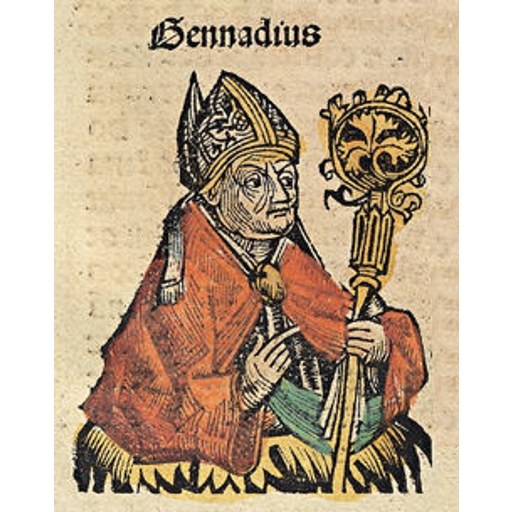
Michel Wolgemut, Wilhelm Pleydenwurff (Text: Hartmann Schedel)
License: Public domain
Gennadius of Constantinople
Saint- Life Span
- d. 471
- Feast Day
- 17 November and 25 August
- Gender
- male
- Church
- Catholic
Places
Roles & Family
Biography
Gennadius I was Patriarch of Constantinople from 458 until his death in 471, during the reign of Emperor Leo I. He succeeded Anatolius on the episcopal throne of the Eastern Roman capital. No reliable source records a year or place of birth, and nothing certain is known of his family, childhood, or formal education. He is attested as a presbyter of Constantinople before his elevation and was already reputed for learning and personal austerity. Later Orthodox tradition numbered him among the saints of the imperial city, but that cult is of the ancient, pre-congregational kind and is not tied to a named act of canonization.
Near-contemporary literary testimony comes from Gennadius of Massilia, who in his catalogue of ecclesiastical writers described the Constantinopolitan patriarch as highly educated and eloquent, the author of a commentary on the Book of Daniel and of treatises against the Anomoean Arians. Most of these works are lost; only notices and fragments remain. His exegesis is associated with the Antiochene school, which favored a more literal reading of Scripture. As patriarch he also left an encyclical, issued with a synod at Constantinople, condemning simony and forbidding the conferral of ordination in return for payment. That concern for the integrity of holy orders is one of the best-attested features of his administration.
His years in office belonged to the unsettled period after the Council of Chalcedon of 451. Gennadius upheld the Chalcedonian definition of the two natures in Christ and opposed Monophysite hierarchs, including Timothy Aelurus of Alexandria. Imperial policy under Leo I, which included the removal of Timothy from Alexandria around 460 and the installation of a Chalcedonian bishop there, aligned with the patriarch’s position. Within the capital he was remembered for strict discipline of the clergy. Hagiographical sources, notably the Life of Daniel the Stylite, present him as seeking to ordain the pillar-saint Daniel, who would not leave his column; according to that narrative Gennadius eventually ordained him at the stylite’s pillar. Such stories, while not independently verifiable in every detail, show how fifth- and sixth-century memory cast him as a severe but holy hierarch.
Gennadius died in Constantinople on 25 August 471. The Eastern Orthodox Church commemorates him on 17 November and also on 25 August. No reliable source names a spouse, children, a monastic order, a precise burial church, or any specialized patronage of places, professions, or causes. What can be said with confidence is that he was a fifth-century Chalcedonian patriarch of Constantinople, a biblical commentator of the Antiochene type, and an opponent of simony, whose memory was preserved in both Latin literary catalogues and Greek liturgical calendars.