Gerald of Aurillac is a saint of the Catholic Church (855 - 909). Gerald of Aurillac's feast day is celebrated on 13 October. Gerald of Aurillac is the patron saint of Aurillac;Upper Auvergne;bachelors;counts;nobles;people with disabilities.
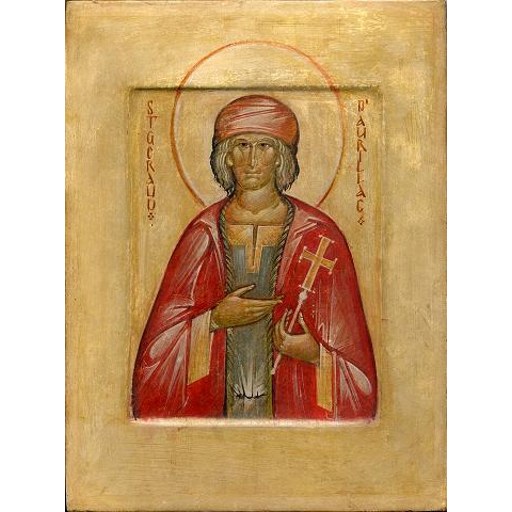
License: CC BY-SA 4.0
Gerald of Aurillac
Saint- Life Span
- 855 - 909 (age 54)
- Feast Day
- 13 October
- Gender
- male
- Church
- Catholic
Places
Roles & Family
Patronage
Aurillac;Upper Auvergne;bachelors;counts;nobles;people with disabilities
Biography
Gerald of Aurillac, known in French as Géraud d'Aurillac, was a Carolingian count and Christian lay saint of the Auvergne in what is now south-central France. He was born about 855 into a family of regional nobility. His father, Count Gerald, and his mother, Adaltrude, belonged to the Gallo-Roman aristocracy that still held local power in the late ninth century. According to the Life composed by Odo of Cluny in the early tenth century, Gerald was a delicate child who suffered from a serious skin disease and, in later years, from episodes of blindness. He received an education unusual for a lay noble of his time, including instruction in letters and in the scriptures, and from youth he showed a strong inclination toward prayer and continence.
When he inherited the county of Aurillac, Gerald exercised the ordinary duties of a Frankish count: holding courts, defending his lands, and managing a household of armed retainers. He never married and is consistently described as having remained a virgin, resisting the expectation that a count must take a wife and secure the succession. He tried to restrain private warfare and the abuse of the poor by his own men, and he preferred ransom and negotiation to killing. His wealth was directed toward alms, the support of churches, and the foundation of a Benedictine monastery at Aurillac, dedicated to Saint Peter, which he richly endowed and for which he obtained papal protection in the later ninth century. He himself did not become a monk. He remained a layman, attending the divine office when circumstances allowed and following a personal discipline of fasting, chastity, and night prayer.
Gerald made pilgrimages to Rome and cultivated devotion to the apostles. Stories preserved by Odo and by later local tradition present him as a wonder-worker who healed the sick and protected the weak, and as a rare example of a great lord who sought to live the Gospel without abandoning secular office. He died on 13 October 909 and was buried in the church of the monastery he had founded, which in time took his name and became the Abbey of Saint-Géraud at Aurillac. A cult grew rapidly around his tomb. Odo of Cluny composed the Vita Sancti Geraldi at the request of the monks and of Bishop Turpin of Limoges, offering Gerald as a model of holiness available to the laity and to the military aristocracy.
The feast of Saint Gerald is observed on 13 October. He is venerated as patron of Aurillac and of the Haute-Auvergne, and has traditionally been invoked by bachelors, by counts and nobles, and by people living with physical disabilities. His recognition as a saint belongs to the era of local episcopal and popular cult rather than to a later papal canonization. The abbey he founded later became an important religious and intellectual centre in the Auvergne; among those associated with its tradition was Gerbert of Aurillac, who became Pope Sylvester II.