Gerald of Braga is a saint of the Catholic Church (d. 1108). Gerald of Braga's feast day is celebrated on 5 December. Gerald of Braga is the patron saint of Braga;Archdiocese of Braga.
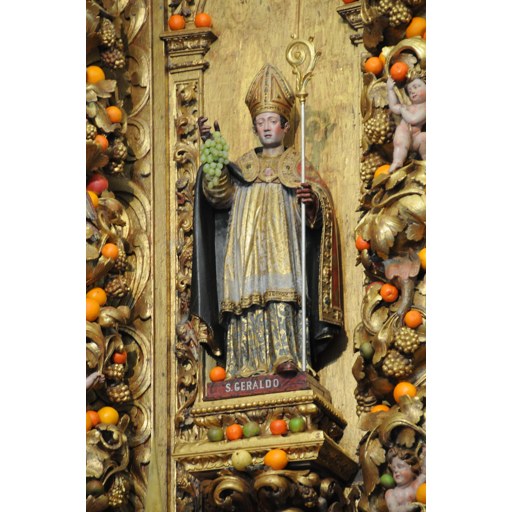
Joseolgon
License: CC BY-SA 3.0
Gerald of Braga
Saint- Life Span
- d. 1108
- Feast Day
- 5 December
- Gender
- male
- Church
- Catholic
Places
Relics & Where to Venerate
Location unknown
The bodily remains of Gerald of Braga are a first-class relic. Venerated at Braga Cathedral.
Roles & Family
Religious Information
Patronage
Braga;Archdiocese of Braga
Biography
Gerald of Braga (Portuguese: São Geraldo de Braga; also known as Gerald of Moissac) was a French Benedictine monk who became metropolitan archbishop of Braga in the late eleventh century. He was born at Cahors in Quercy, in southern France; no contemporary source records the year of his birth, and later round figures sometimes offered for it are not historically verified. He entered the Benedictine abbey of Saint-Pierre de Moissac, a house of Cluniac observance, and was formed there in the monastic, liturgical, and disciplinary traditions of the Gregorian Reform. Moissac supplied a number of clergy to the Iberian Church after the Christian capture of Toledo in 1085.
Bernard of Sédirac, a former monk of Moissac who had been made archbishop of Toledo, recruited trained monks to restore Latin ecclesiastical life and to replace the Mozarabic rite with the Roman liturgy. Gerald was among those who went from Moissac to the Iberian Peninsula. At Toledo he served in the cathedral church; later accounts describe him as cantor or as otherwise assisting in liturgical and administrative reorganization under Bernard. In the mid-to-late 1090s he was appointed to the restored metropolitan see of Braga in the northwest of the peninsula, in the territory of the County of Portugal within the Leonese realm. He received episcopal consecration and subsequently the pallium, and he worked to recover the rights, property, and discipline of his church.
As archbishop he sought to enforce clerical celibacy, to suppress simony, and to reclaim alienated ecclesiastical estates. He asserted Braga’s metropolitan and primatial claims over sees in the northwest, which brought him into lasting jurisdictional conflict with Toledo and with Santiago de Compostela. He obtained papal support for Braga’s status, including from Paschal II, while the rivalry among the Iberian metropolitans continued. He also promoted the rebuilding and endowment of the cathedral of Braga and the reform of diocesan clergy and worship along Roman and Cluniac lines. Surviving notices of his episcopate are limited, and much of what is known comes from later local tradition and from the broader documentary record of the primatial disputes.
Gerald died on 5 December 1108 (some later notices give 1109), according to Portuguese tradition while on a pastoral visitation at Bornes in the district of Vila Pouca de Aguiar. His body was taken to Braga and buried in the cathedral, where his tomb became a focus of local veneration. He was honoured as a saint from an early date by popular cult of the pre-Congregation type; no record survives of a formal papal canonization in the later medieval sense. His feast is kept on 5 December. He is regarded as a patron of the city and archdiocese of Braga. The historical Gerald must be distinguished from later legendary accretions; the securely attested facts are his Moissac origin, his association with the Toledan reform clergy, his archiepiscopate at Braga, and his early local cult.