Gerard of Csanád is a saint of the Catholic Church (d. 1046). Gerard of Csanád's feast day is celebrated on 24 September. Gerard of Csanád is the patron saint of Hungary;Diocese of Szeged-Csanád.
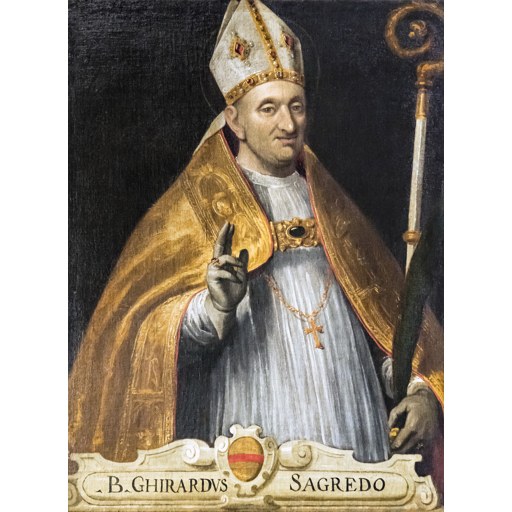
Didier Descouens
License: CC BY-SA 4.0
Gerard of Csanád
Saint- Life Span
- d. 1046
- Feast Day
- 24 September
- Gender
- male
- Church
- Catholic
Places
Roles & Family
Religious Information
Patronage
Hungary;Diocese of Szeged-Csanád
Canonization
Biography
Gerard of Csanád, known in Hungarian as Szent Gellért and in Italian as San Gerardo, was a Venetian Benedictine monk who became the first bishop of Csanád in the Kingdom of Hungary and was martyred in the mid-eleventh century. Later medieval tradition placed his birth in Venice toward the end of the tenth century and associated him with the noble Sagredo family, though that family identification is not confirmed by contemporary records. He entered the Benedictine monastery of San Giorgio Maggiore in Venice and received a monastic and theological education. A substantial Latin treatise that survives under his name, the Deliberatio supra hymnum trium puerorum, shows wide reading in patristic and early medieval theology and remains one of the principal intellectual monuments of the early Hungarian church.
In the 1020s Gerard left Italy intending to go on pilgrimage to the Holy Land. While passing through Hungary he was received by King Stephen I, who persuaded him to remain in the kingdom. For some years he lived as a hermit in the Bakony forest, at Bakonybél. Stephen then charged him with the education of the royal heir, Prince Emeric. After the king had defeated the local ruler Ahtum (also called Ajtony) and brought the Maros region under firmer royal control, a new diocese was erected with its seat at Csanád. Gerard was appointed its first bishop around 1030 and held the see until his death.
As bishop he organized a cathedral, a chapter, a monastic house dedicated to Saint George, and a school for clergy in a territory that was still religiously mixed and only recently integrated into the Latin ecclesiastical structure of the Árpád kingdom. His Deliberatio, written for a monk named Isingrim, is an allegorical commentary on the canticle of the three young men in the Book of Daniel and attests to his activity as a teacher and theologian as well as an administrator. After Stephen died in 1038, Hungary entered a period of succession struggles and pagan reaction. Gerard remained a leading representative of the Latin hierarchy that had been built up under the first king.
In 1046 a pagan uprising associated with the chieftain Vata erupted as the princes Andrew and Levente returned from exile. Gerard and other prelates were traveling toward the Danube crossings at Pest to meet the returning dynasts when they were attacked. Medieval legends report that he was seized on the hill above Buda later named Gellért Hill and killed on 24 September 1046, by being cast down from the heights in a cart and then stabbed or stoned. He was among the most prominent clerical victims of that revolt. His body was recovered and, after an initial burial, translated to the cathedral of Csanád, which became the center of his cult.
In 1083, during the reign of King Ladislaus I and with the involvement of Pope Gregory VII, Gerard was raised to the honors of the altar together with King Stephen and Prince Emeric. He has since been venerated in the Catholic Church as a bishop and martyr. His feast day is 24 September. He is honored as one of the patron saints of Hungary and as the founder-patron of the Diocese of Csanád, today the Diocese of Szeged-Csanád. Churches and relics associated with him survive in Hungary and in Venice, and the hill of his martyrdom is a major landmark of Budapest.