Gerlind vom Elsass is a blessed of the Catholic Church.
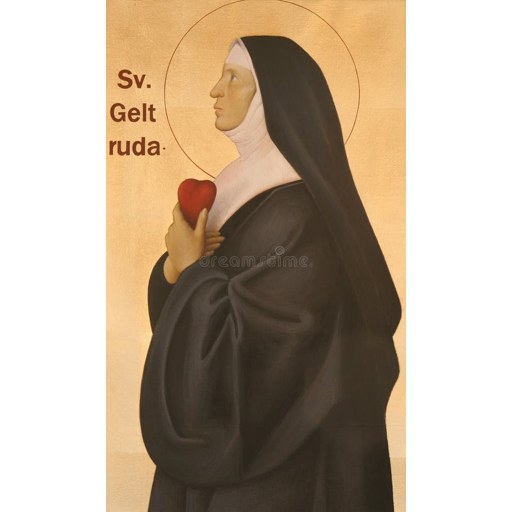
https://dreamstime.com/photos-images/saint-painting.html
License: unknown
Gerlind vom Elsass
Blessed- Gender
- female
- Church
- Catholic
Roles & Family
Biography
The name Gerlind vom Elsass (Gerlind of Alsace) designates a woman associated with the historical region of Alsace, called Elsass in German, a territory on the long-contested frontier between the German-speaking and Romance worlds. In the early and high Middle Ages Alsace belonged to the sphere of the Etichonid dukes and later to the Holy Roman Empire. It was a landscape of powerful Benedictine and canonical houses—Hohenburg (Mont Sainte-Odile), Niedermünster, Murbach, and the church of Strasbourg—and of noble kindreds whose daughters frequently entered religion. The personal name Gerlind (also Gerlinde) is a Germanic feminine compound, from elements commonly glossed as “spear” and “soft” or “linden,” and is attested among medieval elites in the German-speaking lands. The toponymic “vom Elsass” records a regional association; it does not by itself prove a birthplace, a dynasty, or a cult.
No chronicle, charter, necrology, or vita that is securely cited in modern critical historiography supplies a verified year of birth or death, a precise town of origin, a place of burial, or a documented spouse or offspring for this Gerlind. It is therefore not possible to say whether she belonged to the Etichonid ducal house, to a later comital family, or to a monastic community, nor whether she was remembered in her own time as a foundress, an abbess, a lay noblewoman, or a saint. Later Alsatian tradition sometimes attached additional female names to the circle of Saint Odilia of Hohenburg, whose cult dominated regional religious memory from the early Middle Ages. Such attachments are often legendary. They cannot be treated as historical fact without a contemporary source. In the absence of a charter, a reliable martyrological entry, or a critically edited life, claims about office, marriage, children, religious profession, or patronage must remain open.
Alsace did produce a number of better-documented holy women whose outlines can be recovered from medieval sources and later scholarship: Odilia of Hohenburg herself, Attala of Strasbourg, Eugenia of Hohenburg, and Gundelindis of Niedermünster among them. Gerlind vom Elsass, under the form of the name given here, does not clearly correspond to any of those figures. Equating her with Gundelindis or with another known abbess would be a substitution, not a demonstration. Because the subject is obscure in the surviving record, any reconstruction that assigned her a specific century, a particular house, a feast day, or a papal process of beatification or canonization would be speculative.
The appearance of such a name in modern databases may reflect a lemma in a regional lexicon, a diocesan or genealogical compilation, or a variant spelling rather than an independent medieval dossier. Researchers who encounter Gerlind vom Elsass should look to Alsatian necrologies, the charters of the bishopric of Strasbourg, and the records of Hohenburg and related houses, while remaining aware that many entries in such lists cannot be converted into a full biography. No canonization or beatification associated with this name is known from the standard repertories of the Holy See. Until a primary source or a critical scholarly notice can be produced, the responsible course is to record the feminine name and the Alsatian association and to leave chronological, familial, and institutional details blank.