German of Solovki is a venerable of the Catholic Church (d. 1479). German of Solovki's feast day is celebrated on 30 July, 8 August.
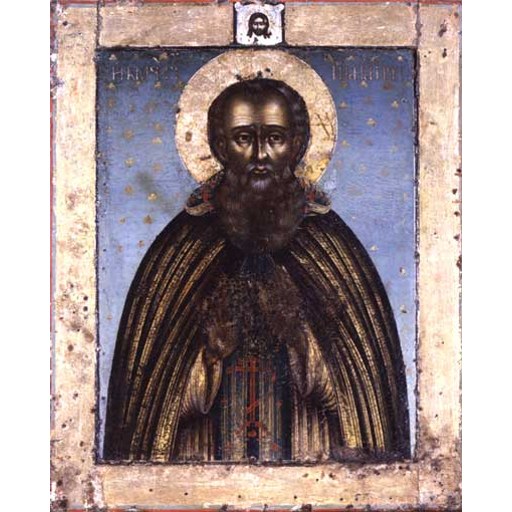
Unknown authorUnknown author
License: Public domain
German of Solovki
Venerable- Life Span
- d. 1479
- Feast Day
- 30 July, 8 August
- Gender
- male
- Church
- Catholic
Places
Roles & Family
Biography
Saint Herman of Solovki (also called German of Solovki or German Solovetsky) was a fifteenth-century Russian Orthodox monk and hermit, venerated as one of the three founding fathers of the Solovetsky Monastery on the Solovetsky Islands in the White Sea, together with Saints Sabbatius (Savvaty) and Zosima. Almost nothing historically secure is known of his birth, family, or early years. Later hagiographical tradition sometimes links him with the northern town of Totma, but that association is not firmly established in the earliest sources and should be treated as unverified. He enters the record as an already formed ascetic living in solitude on the White Sea coast, near the mouth of the Vyg River, in the orbit of Novgorodian northern colonization and monastic expansion.
According to the traditional Lives of the Solovki saints, around 1429 Herman met Sabbatius, a monk who had left the Kirillo-Belozersky Monastery in search of stricter solitude. The two crossed to the then largely uninhabited Solovetsky Island, erected a wooden cross and a cell, and began an eremitical life of prayer, fasting, and hard physical work, including fishing and gathering. After some years Sabbatius left the island and died on the mainland in 1435, while Herman was away. Herman later returned and, in the mid-1430s, was joined by Zosima. Herman’s knowledge of the island, its climate, and its waters made him the practical guide of the new settlement; Zosima became the community’s first abbot as the hermitage developed into a cenobitic monastery. Herman is portrayed in the sources as an elder of humility and endurance rather than as an administrative superior.
The small island community grew into one of the principal monastic, economic, and missionary centres of the Russian North. Herman outlived Zosima, whose death is traditionally dated to 1478. The standard hagiographical account states that the aged Herman then travelled to Novgorod on monastery business—seeking blessing for a new abbot and attending to the house’s legal and material affairs—and died there in 1479. His body was at first buried in Novgorod; monastery tradition dates the translation of his relics to Solovki to 1484. Thereafter he was buried and venerated at the Solovetsky Monastery together with Zosima and Sabbatius. Precise archival confirmation of these late-life movements is limited; the dates belong to the received monastic tradition rather than to independent contemporary chronicle entries.
Herman was a monk, not a bishop, patriarch, or pope, and he lived in monastic celibacy. He is commemorated in the Eastern Orthodox Church, especially in the Russian tradition, on 30 July and jointly with Zosima and Sabbatius on 8 August, as well as in related synaxes of Solovki saints. His relics have been honoured at the Solovetsky Monastery. Beyond these liturgical and hagiographical facts, the documentary base for his biography remains thin: no verified birth year, no securely attested birthplace, and no contemporary non-hagiographical narrative of his inner life or miracles. What can be said with caution is that he was a formative companion of the Solovki founders in the second and third quarters of the fifteenth century and that his cult was established at the monastery by the late fifteenth century and continued in the Russian Orthodox calendar.