Germanus is a saint of the Catholic Church (d. 448). Germanus's feast day is celebrated on 31 July. Germanus is the patron saint of Auxerre.
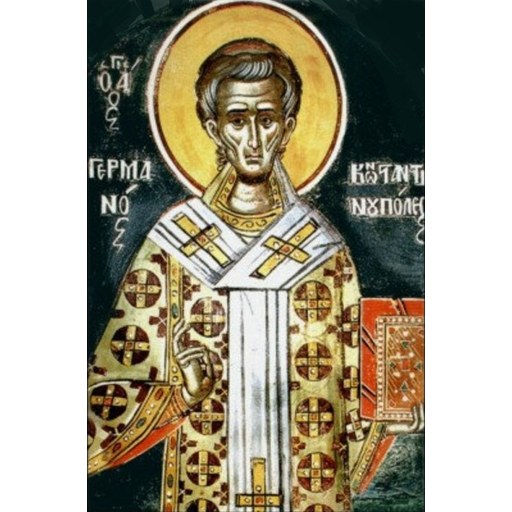
https://handmadeiconsgreece.myshopify.com/en-us/products/saint-germanus-patriarch-of-constantinople
License: unknown
Germanus
Saint- Life Span
- d. 448
- Feast Day
- 31 July
- Gender
- male
- Church
- Catholic
Places
Roles & Family
Patronage
Auxerre
Biography
Saint Germanus of Auxerre was a Gallo-Roman bishop of the fifth century, known chiefly from the Vita Germani composed by Constantius of Lyon around 480, within living memory of his subject. He was born at Auxerre (Autissiodorum) in Roman Gaul to a family of senatorial rank. The precise year of his birth is not recorded in contemporary sources and is only estimated by later writers. He received a classical education and studied law at Rome, then practised as an advocate and rose to high civil office in the imperial administration, a career later remembered as that of a dux. Constantius states that he married a woman of comparable standing, though her name is not given in the early Life. Near the end of the episcopate of Amator of Auxerre, Germanus was tonsured and designated as successor; he was consecrated bishop of Auxerre and held that see for roughly three decades. As bishop he adopted an austere manner of life, disposed of much of his property, and established a monastery on the far bank of the Yonne opposite the city.
Germanus’s most fully attested public actions concern the British Church. In 429, according to Prosper of Aquitaine, Pope Celestine I authorised him to go to Britain, and Constantius describes the journey as undertaken together with Lupus of Troyes at the request of British clergy in order to check Pelagian teaching. The Vita recounts a public disputation in which the Catholic party prevailed, and the so-called Alleluia Victory, in which Germanus, drawing on his earlier military experience, organised a British force against raiding Saxons and Picts; a shout of Alleluia from an ambush is said to have put the enemy to flight without a pitched battle. A second journey to Britain is reported toward the end of his life, but its date and circumstances are less securely attested than the visit of 429. Later medieval writers linked Germanus with the formation of Saint Patrick; that association is absent from Constantius and is treated with caution by modern historians.
Toward the close of his life Germanus travelled to the imperial court at Ravenna to intercede for the Armoricans of Gaul, who had been implicated in revolt and were threatened with severe punishment by the magister militum Aetius and his Alan allies. He was received by the emperor Valentinian III and the empress mother Galla Placidia. He died at Ravenna on 31 July in the year traditionally given as 448. His body was brought back to Auxerre and buried in the oratory he had dedicated to Saint Maurice, a site that later became the Abbey of Saint-Germain. His feast is kept on 31 July. He is venerated as the principal patron of Auxerre. Because his cult belongs to late antiquity, there was no formal process of canonization or beatification of the later medieval type.