Germanus I of Constantinople is a saint of the Catholic Church (634 - 740). Germanus I of Constantinople's feast day is celebrated on 12 May.
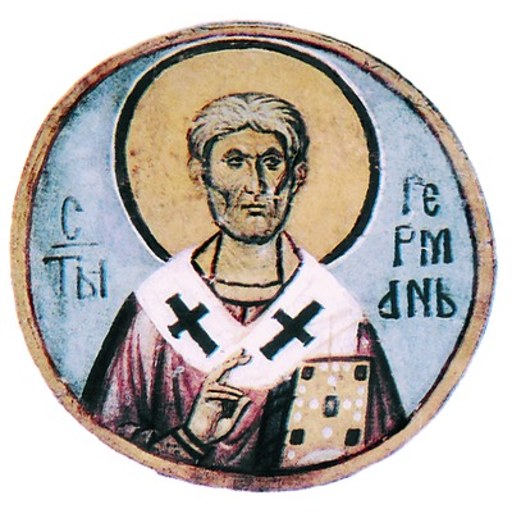
AnonymousUnknown author
License: Public domain
Germanus I of Constantinople
Saint- Life Span
- 634 - 740 (age 106)
- Feast Day
- 12 May
- Gender
- male
- Church
- Catholic
Places
Relics & Where to Venerate
Location unknown
The bodily remains of Germanus I of Constantinople are a first-class relic. Venerated at Chora Church.
Roles & Family
Canonization
Biography
Germanus I was born in Constantinople around 634 into a senatorial family of high standing. His father, the patrician Justinian, served in the imperial administration but was later put to death on the orders of Emperor Constantine IV. According to the chronicler Theophanes Confessor, the young Germanus was castrated in connection with his father’s fall and was placed among the clergy of the Great Church of Hagia Sophia. Thereafter he was formed entirely within the ecclesiastical world of the capital, receiving a thorough education in Scripture, the Greek Fathers, and the liturgical and canonical traditions of Constantinople. By the opening of the eighth century he had risen to become metropolitan bishop of Cyzicus, an important see on the Hellespont and a customary stepping-stone toward the patriarchate.
His years at Cyzicus fell in a time of sharp doctrinal and political instability. During the brief restoration of Monothelitism under Emperor Philippikos Bardanes (711–713), Germanus, like a number of other bishops, appears to have accommodated the imperial religious policy. After Anastasius II restored Dyothelite orthodoxy, Germanus publicly recanted any such association. In 715 he was elected Patriarch of Constantinople, succeeding John VI, and he held the see through the short reign of Theodosius III and the early years of Leo III the Isaurian. He is recorded as having crowned Leo emperor in 717. In the first phase of his patriarchate he worked to repair the damage of the Monothelite episode, to regularize relations with the other patriarchates, and to maintain communion with the Roman see.
Germanus’s lasting historical importance rests on his resistance to the iconoclastic policy begun by Leo III. From about 726 the emperor moved against the public veneration of icons. Germanus opposed the new course on theological grounds, holding that images of Christ and the saints were consistent with the Incarnation and with the received tradition of the Church. He corresponded with bishops already inclined toward iconoclasm, among them Constantine of Nakoleia, and he sought to keep traditional practice intact in the capital. He also exchanged letters with Pope Gregory II on the unfolding controversy. In January 730 Leo convened a silentium and demanded that the patriarch subscribe to the imperial policy. Germanus refused, laid down his omophorion, and was deposed (or allowed to resign) on 17 January 730. He was replaced by the iconoclast Anastasius.
After his removal Germanus withdrew to the family property at Platanion in Constantinople. A substantial body of writing is associated with his name, including letters on the theology of images, homilies (notably on the Presentation and the Annunciation, which are of importance for later Marian doctrine), a treatise on heresies and councils, and an exposition of the Divine Liturgy often called the Historia ecclesiastica or Mystagogy, though modern scholars have questioned the authenticity of some items in the corpus. He was among the earliest and most prominent hierarchical opponents of iconoclasm, writing from within the empire itself rather than from outside its borders. The Seventh Ecumenical Council (Nicaea II, 787) later honored his memory as a defender of the holy icons.
He died at Constantinople, according to the tradition most widely received in the liturgical calendars, in 740, and was buried at the Monastery of Chora. Some earlier Western reference works give 733 as an alternative year of death; the precise date is not established beyond dispute. Both the Eastern Orthodox Church and the Catholic Church venerate him as a saint, with his principal feast on 12 May. In the East he is remembered as a hierarch who accepted deposition rather than abandon the tradition of the Church, and as a theological witness to the legitimacy of icon veneration in the generation before the Second Council of Nicaea.