Giovanni Alberto Badoer is a venerable of the Catholic Church (1649 - 1714).
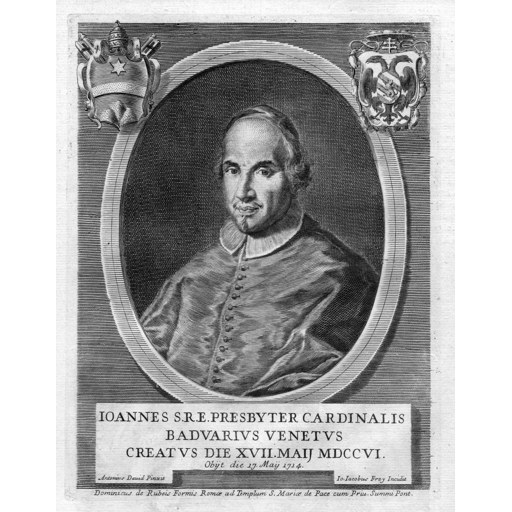
Johann Jakob Frey the Elder
License: Public domain
Giovanni Alberto Badoer
Venerable- Life Span
- 1649 - 1714 (age 65)
- Gender
- male
- Church
- Catholic
Places
Relics & Where to Venerate
Location unknown
The bodily remains of Giovanni Alberto Badoer are a first-class relic. Venerated at Duomo Nuovo.
Roles & Family
Biography
Giovanni Alberto Badoer (also found as Badoaro) was a Venetian patrician, bishop, and cardinal of the Roman Catholic Church in the later seventeenth and early eighteenth centuries. He was born in Venice in 1649 into the Badoer family, an old noble house of the Republic counted among the case vecchie. Like many Venetian aristocrats destined for high ecclesiastical office, he was trained in the law and took a doctorate in both canon and civil law at the University of Padua, the principal university of the Venetian state. He entered the clerical career, was ordained a priest, and served in Rome in juridical posts, including as a referendary of the Tribunals of the Apostolic Signatura of Justice and of Grace. He belonged to the secular clergy rather than to a religious order.
In 1688 Pope Innocent XI named him Patriarch of Venice, and he received episcopal consecration. For some eighteen years he headed the Venetian church. The Latin Patriarchate of Venice, created in the fifteenth century by the transfer of the ancient title of Grado, was among the most prestigious Catholic sees in Italy and was customarily reserved to a Venetian noble who could mediate between the Signoria and the Holy See. Badoer’s patriarchate belongs to the ordinary administrative history of that office rather than to hagiography: he is attested as a learned prelate and diocesan governor, not as a miracle-worker, founder, or popular saint, and no feast day or patronage is attached to his name.
In 1706 Pope Clement XI created him cardinal priest and assigned him the titular church of San Marcello in Rome. In the same year he was translated from Venice to the Diocese of Brescia, a major see on the Venetian Terraferma, which he governed as bishop while remaining a member of the Sacred College. Because Clement XI’s pontificate continued until 1721, Badoer never sat in a papal conclave. He was never Bishop of Rome, nor did he hold an Eastern patriarchal or catholicosal see; the Venetian patriarchate was a Latin Catholic dignity.
He died in Brescia in 1714, in his mid-sixties. Bound by the celibacy of the Latin priesthood, he is not recorded as having married or as having had children. He was neither beatified nor canonized. His career is that of a well-born Venetian churchman of the later baroque age: legal education, curial service, a patriarchal appointment in his native city, the red hat, and death as bishop of a mainland diocese.