Giovanni da Parma is a saint of the Catholic Church (d. 1289). Giovanni da Parma's feast day is celebrated on 20 March.
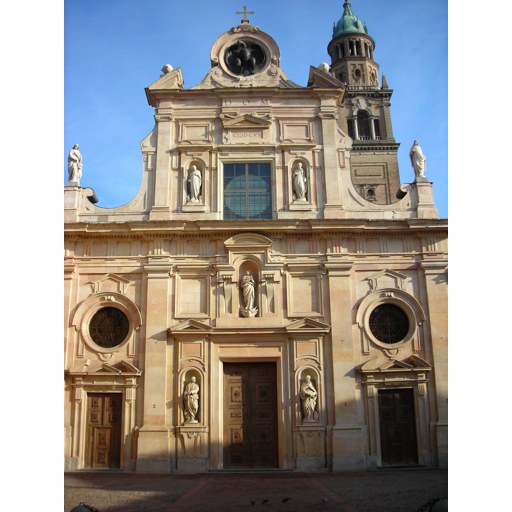
Negri.stefano
License: CC BY-SA 3.0
Giovanni da Parma
Saint- Life Span
- d. 1289
- Feast Day
- 20 March
- Gender
- male
- Church
- Catholic
Places
Roles & Family
Religious Information
Canonization
Biography
Giovanni da Parma, known in English as Blessed John of Parma and in religion as Giovanni Buralli, was a thirteenth-century Franciscan friar and Minister General of the Order of Friars Minor. He was born in Parma in northern Italy in the early thirteenth century, into the Buralli family. As a young man he taught logic in the schools of Parma and gained a reputation for intellectual ability before entering the Franciscan order. After his profession he was sent to the order’s major houses of study, including Paris and Bologna, where he lectured in theology. His learning, combined with a personal commitment to poverty and austerity, made him a prominent figure among the Friars Minor in the generation after Saint Francis.
In 1247 the general chapter meeting at Lyons elected him Minister General in succession to Crescentius of Jesi. Over the next ten years he devoted himself to visiting the provinces of the order, traveling on foot through Italy, France, the Iberian Peninsula, and England. He sought to recall the friars to a stricter observance of the Rule and to restrain the mitigations that had accompanied the order’s growth, its involvement in universities, and its pastoral privileges. He encouraged missionary work and maintained an interest in relations with the Greek Church, sending representatives toward the Byzantine world. Admirers regarded him as a restorer of primitive Franciscan life; critics already associated him with the Joachite current that expected an imminent age of the Holy Spirit.
That association became dangerous after 1254, when the friar Gerard of Borgo San Donnino issued an Introduction to the Eternal Gospel that treated the writings of Joachim of Fiore as a new dispensation destined to supersede the New Testament. The book was condemned by a papal commission in 1255. Giovanni’s known sympathy for Joachim’s ideas and for the Spiritual party within the order exposed him to charges of unsound doctrine, which were pressed by conventual friars and by secular masters at Paris who opposed mendicant privileges. At the general chapter of 1257 he resigned the generalate; Saint Bonaventure was chosen to replace him. A subsequent inquiry required Giovanni to make a profession of orthodox faith, after which he was allowed to withdraw to the hermitage of Greccio in the Rieti valley, a site closely linked to the memory of Saint Francis.
He remained at Greccio for many years, living in retirement yet continuing to attract those who looked to him as a model of Franciscan poverty. In 1289 Pope Nicholas IV, a Franciscan, named him papal legate to the Byzantine emperor in another effort to heal the schism between the Latin and Greek churches. Giovanni set out for the East but died on the journey at Camerino in the Marche on 19 March 1289. He was buried in that city. A local cult grew up at his tomb. In 1777 Pope Pius VI confirmed his beatification. He is commemorated on 20 March in the Franciscan liturgical calendar. He was not subsequently canonized, and no extensive list of patronages is attached to his name in reliable sources.