Girolamo de Angelis is a blessed of the Catholic Church (1567 - 1623). Girolamo de Angelis's feast day is celebrated on 4 December.
Eannatum
License: Public domain
Girolamo de Angelis
Blessed- Life Span
- 1567 - 1623 (age 56)
- Feast Day
- 4 December
- Gender
- male
- Church
- Catholic
Places
Roles & Family
Religious Information
Canonization
Biography
Girolamo de Angelis, known in English as Jerome de Angelis, was born in 1567 at Castrogiovanni (the present-day city of Enna) in central Sicily, then under Spanish Habsburg rule as part of the Kingdom of Sicily. He entered the Society of Jesus in the 1580s and completed the ordinary Jesuit course of studies before ordination to the priesthood. Like many Italian and Iberian Jesuits of his generation, he volunteered for the overseas missions and was assigned to Japan, where the Jesuit enterprise begun by Francis Xavier in the previous century had produced a large community of converts, especially in Kyushu, even as political suspicion of Christianity was already rising.
He reached Japan in 1602 and spent the following years in pastoral work among Japanese Christians and in the instruction of catechumens. He is particularly associated with evangelization in northern Honshu. In 1618 he traveled to the Matsumae domain on the island of Ezo (modern Hokkaido), becoming the first Catholic missionary known to have reached that island. He wrote a report on the country and on the Ainu people, which remains one of the earliest European accounts of the region.
After the Tokugawa shogunate issued its nationwide ban on Christianity in 1614 and ordered the expulsion of missionaries, de Angelis was among those who refused to leave. For nearly a decade he lived in hiding, moving from place to place and continuing to administer the sacraments to underground Christian communities as searches for priests and for Japanese believers grew more severe.
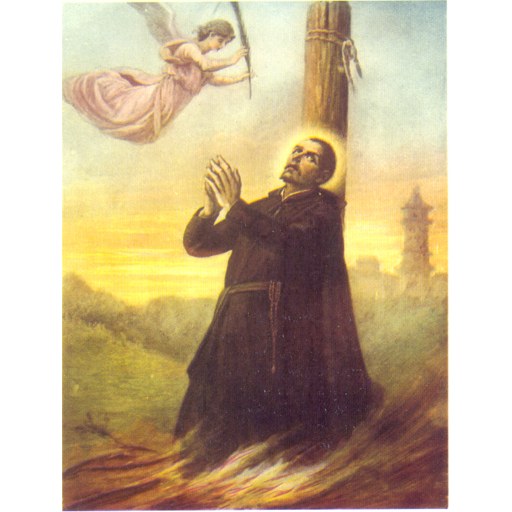
In 1623 he was arrested in Edo, the shogunal capital (present-day Tokyo). On 4 December 1623 he was executed by burning at the stake, together with the Franciscan missionary Francisco Gálvez and the Japanese Jesuit brother Simon Yempo, in a large public execution of Christians in the capital. Pope Pius IX beatified him in 1867 as one of the 205 Martyrs of Japan. He is venerated as a blessed of the Catholic Church; he was not subsequently canonized as an individual saint.