Gonario II of Torres is a blessed of the Catholic Church.
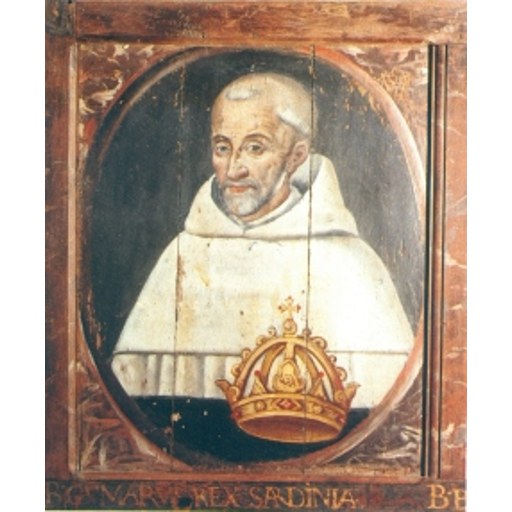
Unknown authorUnknown author
License: Public domain
Gonario II of Torres
Blessed- Gender
- male
- Church
- Catholic
Places
Roles & Family
Religious Information
Biography
Gonario II of Torres, whose name also appears in the forms Gonnario and Gunnari, was giudice of Logudoro (Torres), one of the four independent judicates of medieval Sardinia, in the first half of the twelfth century. He belonged to the Lacon-Gunale dynasty. His father was Constantine I, giudice of Torres, and his mother was Marcusa de Gunale. Later tradition places his birth at Porto Torres, the chief port of the Logudoro, in the early twelfth century; no contemporary document preserves an exact year of birth. Constantine I died while Gonario was still a child, probably in the later 1120s. The minority of the heir exposed the giudicato to the ambitions of powerful local lineages, notably the Athen family. Marcusa therefore took her son from the island and placed him under the protection of the Republic of Pisa, the maritime power that already enjoyed close commercial and political ties with Torres. Gonario spent his formative years in Pisa among the city’s noble houses and there received an upbringing that bound him lastingly to Pisan interests and to the reformed Latin Church.
While in Pisa he married Maria, daughter of the Pisan viscount Ugo da Parlascio Ebriaco. The marriage secured for him the military backing of Pisa. In or about 1130 he returned to Sardinia with Pisan forces, overcame the factions that had filled the vacuum of his absence, and was recognised as giudice of Logudoro. His government was characterised by a firm alliance with Pisa against the rival Ligurian republic of Genoa, and by a policy of favour toward the papacy and the new monastic orders of the continent. He confirmed rights and properties to Pisan churches and merchants in his ports and hinterland. Within Sardinia he had to maintain a balance among the neighbouring judicates of Arborea, Cagliari, and Gallura, whose ruling houses were linked to his own by intermittent kinship and equally intermittent conflict. The title he bore, iudex, denoted a hereditary Christian kingship of Byzantine origin, not a mere judicial office; in practice Gonario ruled as a territorial prince whose authority rested on dynastic right, Pisan support, and the loyalty of the Logudorese estates.
Gonario’s later reputation rests as much on his religious patronage as on his politics. In the climate of the Second Crusade he undertook, in the late 1140s, a pilgrimage to the Holy Land. On the return journey he visited Rome and then the Cistercian abbey of Clairvaux in Champagne, where he met Bernard of Clairvaux. The encounter shaped the remainder of his life. With Cistercian encouragement he promoted the order’s establishment in Sardinia. The principal foundation associated with his name is the abbey of Santa Maria di Corte, also known as Cabuabbas, in the Planargia, which received a colony of monks from Clairvaux. He endowed churches and favoured Gregorian reform against older local ecclesiastical customs. After roughly a quarter-century of rule, and once his succession appeared secure, he decided to renounce power altogether.
In 1153 or 1154 Gonario abdicated in favour of his son Barisone II and retired to Clairvaux, where he took the Cistercian habit and lived as a choir monk. Contemporary and near-contemporary notices indicate that he was still alive after 1182. He died at Clairvaux and was buried at the abbey. By Maria da Parlascio Ebriaco he had issue; the son who succeeded him in Torres was Barisone II. Genealogical reconstructions of the house of Lacon-Gunale also name other sons, including Pietro, Comita, and Ittocorre, though the evidence for each is of uneven weight. Gonario was never formally canonised or beatified, and he has no feast day in the general Roman calendar, nor any widely recognised patronage. He remains a figure of Sardinian dynastic and monastic history: a twelfth-century giudice who recovered his throne with Pisan aid, tied his realm to the Cistercian order, and ended his days as a monk at Clairvaux.