Goneri of Brittany is a saint of the Catholic Church. Goneri of Brittany is the patron saint of Plougrescant.
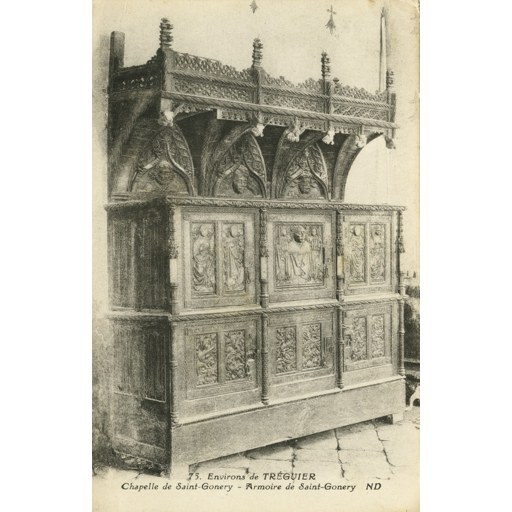
[Neurdein]
License: Public domain
Goneri of Brittany
Saint- Gender
- male
- Church
- Catholic
Places
Roles & Family
Patronage
Plougrescant
Biography
Goneri of Brittany, known in French as Saint Gonéry and associated above all with the coastal parish of Plougrescant in the Trégor, is a sixth-century figure of Breton Christian memory rather than a person whose life can be reconstructed from contemporary records. No vita written in his own age survives, and he does not appear in early martyrologies in a form that would allow firm dates of birth or death. Later hagiographical tradition places him among the British (Insular) clergy and migrants who crossed to Armorica during the period of Anglo-Saxon advance in Britain, a movement that is historically well attested in outline even though individual biographies are not. In that tradition he is a priest who embraced the eremitical life on the wild northern shore of what is now Côtes-d’Armor. Claims that he was of Welsh princely blood, or that he belonged to the immediate circle of Saint Tugdual of Tréguier, belong to the common stock of medieval Breton saint-making and cannot be verified.
What the local tradition consistently maintains is that Goneri settled as a hermit at the site later occupied by the Chapelle Saint-Gonéry in Plougrescant, living in prayer, austerity, and solitude and serving as a priest to the surrounding countryside. Early medieval Brittany produced many such localized cults of immigrant hermits and monk-priests; they typically left no charters and were commemorated first by an oratory, a tomb, and a pardon. Goneri’s cult remained parish-centered. He is not recorded as abbot of a major monastery, as a bishop, or as the holder of any other ecclesiastical office. His eremitical vocation implies a celibate life in the sources that mention him, and no spouse or children are named in the tradition.
The chief monument of his veneration is the late medieval Chapelle Saint-Gonéry at Plougrescant, rebuilt long after his lifetime and famous for a dramatically leaning granite spire and for a fifteenth-century painted wooden ceiling depicting the Last Judgment and related sacred subjects. The chapel is the traditional place of his burial and the focus of his relics and of a local pardon. He is regarded as the patron of Plougrescant. Like many early Breton saints, he was never the object of a formal papal canonization of the later medieval or modern type; his sanctity rested on popular acclaim and on episcopal tolerance of an established cult.
Historians therefore treat Goneri as a name around which a coastal community organized its sacred geography, not as a biography that can be filled in with precise years, family, or miracles. The sixth-century British migration to Armorica makes an Insular priest-hermit on the Trégor coast entirely plausible; the details that later ages attached to his name do not rise to the level of verified fact. He remains, for the careful hagiographer, an obscure but genuine witness to the eremitical and immigrant character of much early Breton Christianity.