Grand Duchess Anastasia Nikolaevna of Russia is a saint of the Eastern Orthodox Church (1901 - 1918). Grand Duchess Anastasia Nikolaevna of Russia's feast day is celebrated on 17 July.
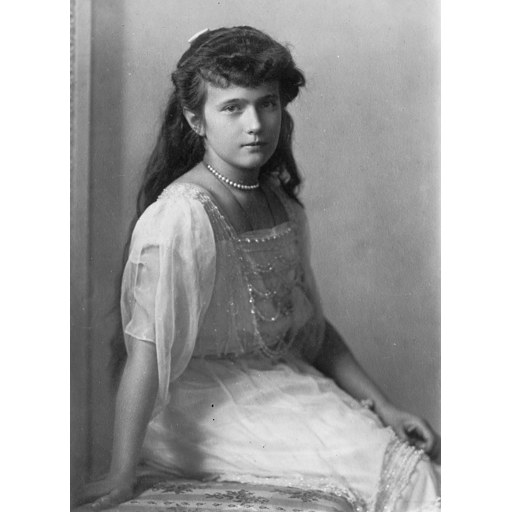
Boissonnas et Eggler, St. Petersburg, Nevsky 24. – Bain News Service, publisher.
License: Public domain
Grand Duchess Anastasia Nikolaevna of Russia
Saint- Life Span
- 1901 - 1918 (age 17)
- Feast Day
- 17 July
- Gender
- female
- Church
- Eastern Orthodox
Places
Relics & Where to Venerate
Location unknown
The bodily remains of Grand Duchess Anastasia Nikolaevna of Russia are a first-class relic. Venerated at Peter and Paul Cathedral.
Roles & Family
Canonization
Biography
Grand Duchess Anastasia Nikolaevna of Russia was born in 1901 at the Peterhof Palace, an imperial residence near Saint Petersburg in the Russian Empire. She was the fourth daughter of Emperor Nicholas II and Empress Alexandra Feodorovna, who had been born Princess Alix of Hesse and by Rhine. Her older sisters were Grand Duchesses Olga, Tatiana, and Maria; her younger brother was Tsarevich Alexei Nikolaevich, the heir apparent, born in 1904 and afflicted with hemophilia. The five children were raised in a close family circle, largely withdrawn from the wider court, and were educated by governesses and tutors in languages, religion, and the accomplishments expected of imperial daughters. They were brought up in the Russian Orthodox Church, which shaped the piety of the household, especially that of the empress.
Contemporary memoirs and letters portray Anastasia as the most high-spirited of the sisters: short in stature, witty, fond of practical jokes, and skilled at imitating courtiers and visitors. She was less studious than Olga or Tatiana and was often in trouble for mischief, yet she was also described as warm-hearted toward family and servants. The children lived mainly at the Alexander Palace at Tsarskoye Selo, with seasons at Peterhof, Livadia in the Crimea, and other residences. Alexei’s recurrent bleeding crises dominated family life and drew the empress toward spiritual healers, most notoriously Grigori Rasputin, whose presence at court damaged the dynasty’s public standing. Anastasia, still a girl, was a witness to this private world rather than a political actor.
When the First World War began, Nicholas II took command at army headquarters and the empress and the two eldest grand duchesses worked as nurses. Anastasia and Maria, too young for full nursing duties, visited wounded soldiers in hospitals at Tsarskoye Selo, wrote letters for them, and played games to lift morale. The February Revolution of 1917 forced Nicholas II to abdicate. The family was held under house arrest at the Alexander Palace, then transported in August 1917 to Tobolsk in western Siberia, where they occupied the former governor’s mansion and continued lessons and household routines under guard. In the spring of 1918 they were moved to Yekaterinburg and confined in the Ipatiev House, designated the House of Special Purpose, under a stricter Bolshevik regime. Contact with the outside world was cut off, windows were whitewashed, and the prisoners’ belongings were searched.
On the night of 16-17 July 1918, as anti-Bolshevik forces neared Yekaterinburg, the Ural Regional Soviet carried out the execution of the imperial family. Nicholas, Alexandra, their five children, and four retainers were shot and bayoneted in a cellar room of the Ipatiev House. The bodies were taken to the Koptyaki forest, mutilated, burned in part, and buried in concealed pits. Soviet authorities long obscured the full circumstances. Because Anastasia’s remains were not publicly accounted for for decades, and because the grave found in the late 1970s and excavated in 1991 contained only nine of the eleven victims, legends of her escape flourished in Europe and America.
Several women claimed to be the surviving grand duchess; the most famous, Anna Anderson, lived for decades under that identity and was the subject of lawsuits and books. DNA testing in the 1990s showed that Anderson was not related to the Romanovs and was consistent with a Polish factory worker’s family. Remains from the main Koptyaki grave were identified by mitochondrial and other DNA as Nicholas II, Alexandra, and three daughters; a second grave found in 2007 contained two further young people identified as Alexei and one daughter. Taken together, the forensic work has been accepted by most historians as proving that Anastasia died with her family in 1918. The Russian Orthodox Church Outside Russia canonized the family as martyrs in 1981. The Moscow Patriarchate canonized Nicholas, Alexandra, and their children as passion-bearers in 2000, with a feast on 17 July. Remains attributed to the emperor, empress, and three daughters were buried in the Peter and Paul Cathedral in Saint Petersburg in 1998, though ecclesiastical acceptance of all identifications has remained cautious in some quarters.