Grand Duchess Maria Nikolaevna of Russia is a saint of the Eastern Orthodox Church (1899 - 1918). Grand Duchess Maria Nikolaevna of Russia's feast day is celebrated on 17 July.
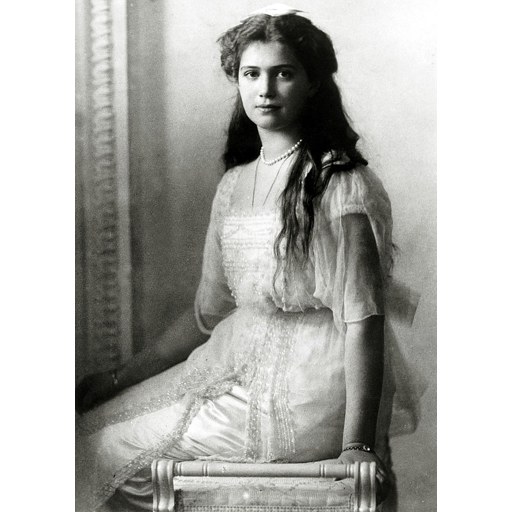
Boasson and Eggler at the Tsarskoe Selo Palace in 1914.
License: Public domain
Grand Duchess Maria Nikolaevna of Russia
Saint- Life Span
- 1899 - 1918 (age 19)
- Feast Day
- 17 July
- Gender
- female
- Church
- Eastern Orthodox
Places
Relics & Where to Venerate
Location unknown
The bodily remains of Grand Duchess Maria Nikolaevna of Russia are a first-class relic. Venerated at Peter and Paul Cathedral.
Roles & Family
Canonization
Biography
Grand Duchess Maria Nikolaevna of Russia was born in 1899 at Peterhof Palace in the Russian Empire, the third daughter of Emperor Nicholas II and Empress Alexandra Feodorovna, who had been Princess Alix of Hesse-Darmstadt. Through her father she belonged to the Holstein-Gottorp-Romanov line; through her mother she was a great-granddaughter of Queen Victoria. She was younger sister to Grand Duchesses Olga and Tatiana and elder sister to Grand Duchess Anastasia and Tsarevich Alexei, whose haemophilia dominated much of the family's private life. The imperial children were raised in a deliberately plain household at Tsarskoye Selo and other residences, with simple clothing, camp beds, and an emphasis on Orthodox piety and duty. Maria was baptized in the Russian Orthodox Church and remained a practicing Orthodox Christian. Within the family she was called Mashka.
Letters, photographs, and later recollections of courtiers and tutors portray her as affectionate, physically strong, and socially open, with a round face and large eyes that led some observers to call her the most typically Russian in appearance of the four sisters. She drew and painted, enjoyed romantic reading, and formed warm attachments to relatives and to officers she met in peacetime and war. During the First World War Olga and Tatiana trained and served as Red Cross nurses, while Maria and Anastasia, still in their mid-teens, regularly visited a hospital at Tsarskoye Selo. They talked with wounded soldiers, wrote letters for them, and played games intended to raise morale. Those years brought the younger grand duchesses into closer contact with ordinary suffering even as the monarchy entered its final political crisis.
After Nicholas II's abdication in 1917 the family was held under house arrest at the Alexander Palace, then sent in August of that year to Tobolsk in Siberia, where they occupied the former governor's mansion under tightening guard. In the spring of 1918 Maria travelled with her parents and Anastasia to Yekaterinburg; Olga, Tatiana, and Alexei followed later because the tsarevich was too ill to move. The prisoners were confined in the Ipatiev House, designated by the Ural Regional Soviet as the House of Special Purpose. Searches, isolation, and reduced rations marked the last months. Contemporary letters and later testimony indicate that Maria remained comparatively outgoing among the sisters, which at times drew both small kindnesses and suspicion from the guards.
In July 1918, with anti-Bolshevik forces approaching the Urals, local Soviet authorities arranged the killing of the prisoners. In the early hours of 17 July, Maria was shot in the basement of the Ipatiev House together with her parents, brother, sisters, and four members of the household, by a Cheka detachment under Yakov Yurovsky. She was nineteen. The bodies were taken to the Koptyaki forest, partly burned, and buried in concealed pits. Remains associated with the imperial family were recovered in the late twentieth century and, in a second grave, in the early twenty-first century. Forensic identification of the individual daughters, especially the distinction between Maria and Anastasia, has been debated among investigators, and the Russian Orthodox Church has treated some of the identifications with caution.
The Russian Orthodox Church Outside Russia glorified Nicholas II and his family as martyrs in 1981. In 2000 the Bishops' Council of the Russian Orthodox Church of the Moscow Patriarchate canonized the emperor, the empress, and their five children as passion-bearers, a category used for those held to have met death in a Christ-like spirit. Their principal feast is 17 July. Remains attributed to members of the family have been interred in the Peter and Paul Cathedral in Saint Petersburg, though discussion of which daughter's bones were found in which grave has continued. Maria was never married and had no children; she is commemorated with her family rather than as the holder of a separate list of patronages.