Gregentius of Taphar is a saint of the Catholic Church. Gregentius of Taphar's feast day is celebrated on 19 December.
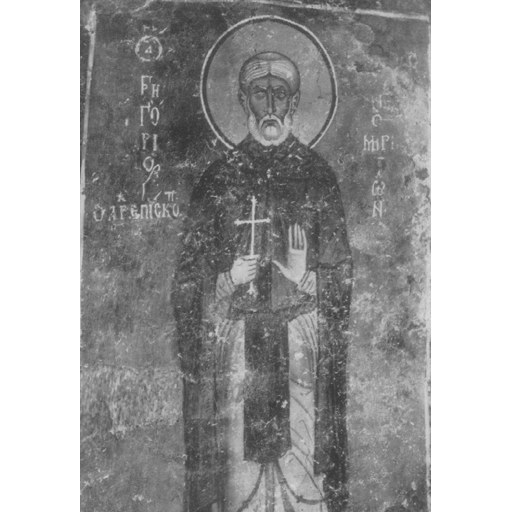
License: Public domain
Gregentius of Taphar
Saint- Feast Day
- 19 December
- Gender
- male
- Church
- Catholic
Places
Roles & Family
Biography
Gregentios, also known as Gregentius of Taphar, is commemorated in the Eastern Orthodox Church as a sixth-century bishop (sometimes styled archbishop) of Taphar, the Greek name for Zafar, capital of the Himyarite kingdom in South Arabia, in what is now Yemen. He is the central figure of a substantial Greek hagiographical and polemical dossier that includes a Life, homilies, a public disputation with a Jew named Herban, and a law code for the Homerites. This material was put together in the Byzantine Empire, most likely in Constantinople during the tenth century. Contemporary sixth-century sources that describe the Christianization of Himyar after the Aksumite conquest do not name Gregentios, and modern historians therefore treat his personal biography as unverified and, in large part, legendary, while still recognizing that a Christian episcopal see at Zafar in that period is historically plausible.
The Life presents Gregentios as a native of Lyplianes, a town it places among the Avars and that scholars have identified with ancient Emona, on the site of modern Ljubljana. It names his father Agapios and describes the death of his mother, his Christian upbringing, and his entry into the monastic life. The narrative then follows him on a long series of journeys through the Mediterranean world, with episodes set in Italy (including Milan), North Africa, Rome, and the East, during which he is portrayed as a wonder-working monk and is eventually ordained. These travels are novelistic in character and contain chronological and geographical anachronisms, such as the presence of Avars in the region of Lyplianes at a date too early for that people, which confirm that the text cannot be used as a straightforward historical record of a sixth-century life.
The historical setting into which the hagiographer inserts Gregentios is the crisis of Christianity in Himyar in the 520s. The Himyarite king Yusuf As'ar Yath'ar, known in Arabic tradition as Dhu Nuwas, converted to Judaism and launched persecutions of Christians, including the well-attested massacre of the Christian community of Najran. In response, the Aksumite king Kaleb (Ella Asbeha, called Elesbaas in Greek sources) invaded South Arabia, defeated Dhu Nuwas, and installed a Christian administration, later associated with the viceroy Abraha. Independent Syriac, Greek, and South Arabian evidence documents this war and the subsequent promotion of Christianity. In the Life, Gregentios is sent, under imperial or papal commission, to organize the church of the Homerites as bishop of Taphar at this court. No inscription or chronicle of the sixth century confirms the name of that bishop.
Writings transmitted under Gregentios's name include the Laws of the Homerites, which claim to be legislation he enacted for a newly baptized Himyarite society and which prescribe severe disabilities for Jews, and the Dialexis, a long debate with Herban that ends in the conversion of the Jewish spokesman. Both works address middle Byzantine concerns about law, conversion, and anti-Jewish polemic rather than the institutions of sixth-century South Arabia, and they are not accepted as authentic documents of a Himyarite church. They do show that Byzantine readers remembered the martyrdoms of Najran and the Ethiopian intervention as a model of royal conversion of a Jewish kingdom.
Gregentios is venerated as a saint in the Eastern Orthodox tradition. His feast day is 19 December. He is variously entitled bishop or archbishop of Taphar, of the Homerites, or, in some older notices, associated with Ethiopia because Himyar then stood under Aksumite overlordship. No reliable source records his year of birth or death, the place of his burial, or any family of his own; the Life depicts him as a monk and bishop without a wife or children. He was not pope or patriarch of any of the ancient patriarchal sees. His historical importance lies less in a recoverable individual career than in the way later Greek Christianity imagined the mission to Himyar and preserved, under his name, a cluster of texts about conversion on the Red Sea frontier.