Gregor von Burtscheid is a saint of the Catholic Church (d. 999). Gregor von Burtscheid's feast day is celebrated on 4 November.
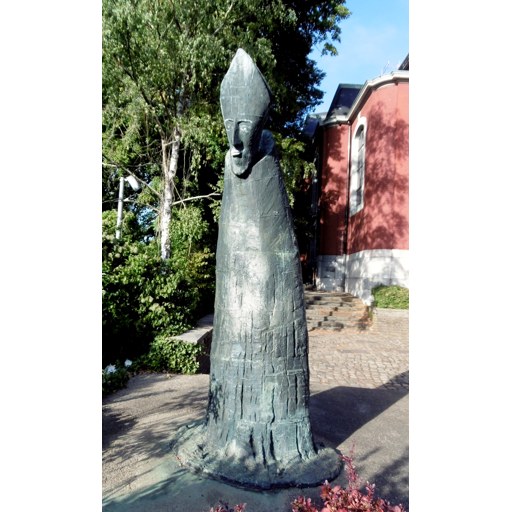
ArthurMcGill
License: CC BY-SA 4.0
Gregor von Burtscheid
Saint- Life Span
- d. 999
- Feast Day
- 4 November
- Gender
- male
- Church
- Catholic
Places
Roles & Family
Religious Information
Biography
Gregor von Burtscheid, known in Latin as Gregorius and sometimes called Gregory of Calabria, was a tenth-century monk and the first abbot of the imperial abbey of Burtscheid, near Aachen. Tradition and later historical writing identify him as a man of Greek origin, born in Calabria in southern Italy. In that period Calabria still belonged to the Byzantine cultural and political sphere and was notable for Greek-speaking monasticism. No contemporary charter or chronicle records his exact birthplace, parentage, or year of birth; estimates that place his birth around the middle of the tenth century are conjectural. What can be said is that he was formed as a monk before he appears in connection with the Ottonian court in the German kingdom.
The later tenth century saw a distinctive movement of Calabrian and other Italo-Greek monks into the Latin West, encouraged in part by the Byzantine connections of the Ottonian dynasty. Empress Theophanu, a Byzantine princess and mother of Otto III, and Otto III himself favoured Greek learning, ceremonial, and asceticism. Otto III, who came of age as emperor in the mid-990s, cultivated contacts with celebrated Greek monks such as Nilus of Rossano. In this climate the emperor founded a monastery at Burtscheid, a site close to the palatine complex of Aachen, traditionally in 997. He installed Gregor as its first abbot. The house was established as a Benedictine abbey and enjoyed the status of an imperial abbey (Reichsabtei), tying it to royal protection and patronage. Gregor's Greek background fitted the emperor's programme of drawing eastern monastic prestige into the heart of the Ottonian realm.
Little detailed evidence survives of Gregor's government of the community. No substantial body of his letters, a contemporary vita of independent historical value, or a rich run of early charters illuminates daily life, the number of monks, or the liturgical rite followed in the first years. He held office only briefly. According to the received chronology he died at Burtscheid in 999, on a date later observed as 4 November. The abbey continued after him as a Benedictine monastery of imperial rank; in the thirteenth century the community's character changed when the house was converted into a Cistercian nunnery, but that transformation lies well after Gregor's lifetime.
After his death Gregor was honoured as a saint, above all in the local tradition of Burtscheid and Aachen. His feast is kept on 4 November. Like many monastic figures of the early and high Middle Ages, he was not the object of a formal papal canonization of the kind that became standard in later centuries; recognition of his sanctity belongs to the older, local and liturgical pattern of cult. He was not a bishop of Rome, nor a patriarch of an Eastern see. As a monk and abbot he lived under monastic vows and is not recorded as having married or had children. Specific patronages of places, trades, or causes beyond the local association with Burtscheid are not securely listed in the standard historical and hagiographical literature. The documentary poverty of his life means that the historian must remain cautious: Gregor is securely placed as a Calabrian Greek monk who became first abbot of Otto III's foundation at Burtscheid and who died there at the close of the tenth century, after which a local cult preserved his name.