Gregorio Barbarigo is a saint of the Catholic Church (1625 - 1697). Gregorio Barbarigo's feast day is celebrated on 18 June. Gregorio Barbarigo is the patron saint of Diocese of Bergamo;Diocese of Padua.
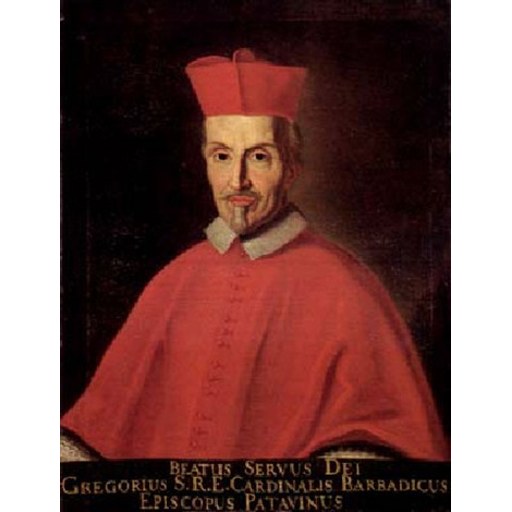
Ermanno Stroiffi
License: Public domain
Gregorio Barbarigo
Saint- Life Span
- 1625 - 1697 (age 72)
- Feast Day
- 18 June
- Gender
- male
- Church
- Catholic
Places
Relics & Where to Venerate
Location unknown
The bodily remains of Gregorio Barbarigo are a first-class relic. Venerated at Tomb of St. Gregorio Barbarigo.
Roles & Family
Patronage
Diocese of Bergamo;Diocese of Padua
Canonization
Biography
Gregorio Giovanni Gaspare Barbarigo was born in 1625 in Venice, capital of the Venetian Republic, into the patrician Barbarigo family, a noble house long involved in the political life of the Serenissima. His father, Giovanni Francesco Barbarigo, belonged to the senatorial class. Gregorio received a broad education in letters, philosophy, mathematics, and law, and he studied at the University of Padua, then among the foremost universities of Europe. While still a young man he was attached to the Venetian embassy of Alvise Contarini at the Congress of Münster, where the treaties ending the Thirty Years' War were negotiated in 1648. That early experience of European diplomacy and of a continent divided by confessional conflict shaped his later emphasis on pastoral charity, catechesis, and interior reform of the clergy rather than on controversy alone.
After returning to Italy he prepared for holy orders and was ordained to the priesthood in the mid-1650s. He soon came to the notice of the Roman court. In 1657 Pope Alexander VII appointed him bishop of Bergamo, a diocese in the Venetian terraferma that still required the systematic application of the disciplinary decrees of the Council of Trent: clerical residence, careful examination of candidates for orders, regular visitation of parishes, and the teaching of Christian doctrine. Barbarigo undertook these tasks with energy and used his family's resources to relieve the poor and to support schools and charitable works. In 1660 Alexander VII created him a cardinal. In 1664 he was translated to the see of Padua, which he governed for more than three decades until his death.
As bishop of Padua he became one of the outstanding Tridentine reformers of seventeenth-century northern Italy. He reorganized and generously endowed the diocesan seminary so that it might form a learned and devout clergy; he held synods and issued constitutions; he conducted painstaking visitations, including of rural parishes; and he promoted catechesis, the printing of religious and scholarly books, and the establishment of libraries. He lived with notable personal austerity, was open-handed toward hospitals and toward those suffering from famine or epidemic, and insisted that his priests observe the canons. At the same time he did not cut the diocese off from the intellectual life of the University of Padua; he encouraged sound studies and maintained relations with men of letters. He took part in papal conclaves in the later seventeenth century but was never elected Bishop of Rome.
Barbarigo died in Padua in 1697. Local veneration began almost at once, fed by the memory of his pastoral labors and by reports of favors attributed to his intercession. He was beatified in 1761 by Pope Clement XIII. The cause then advanced slowly until the twentieth century, when Pope John XXIII—who had been born in the Bergamo region, had served as patriarch of Venice, and regarded Barbarigo as a model diocesan bishop—canonized him in 1960. The Church keeps his feast on 18 June. He is honored as a patron of the dioceses of Bergamo and Padua and is remembered above all as a cardinal-bishop who gave concrete form, in two northern Italian sees, to the reforming program of Trent, especially in the education of the clergy and the instruction of the faithful.