Gregory I is a saint of the Catholic Church (d. 604). Gregory I's feast day is celebrated on 3 September. Gregory I is the patron saint of musicians;singers;teachers;students;popes;England;choirboys;against gout;against plague.
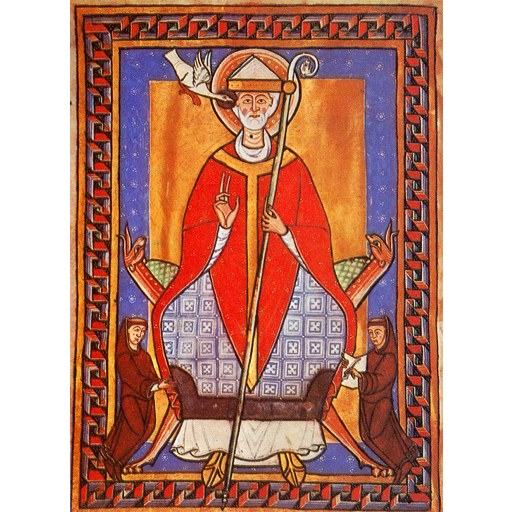
anonymous
License: Public domain
Gregory I
Saint- Life Span
- d. 604
- Feast Day
- 3 September
- Gender
- male
- Church
- Catholic
Places


Relics & Where to Venerate
Location unknown
The bodily remains of Gregory I are a first-class relic. Venerated at St. Peter's Basilica.
Roles & Family
Religious Information
Patronage
musicians;singers;teachers;students;popes;England;choirboys;against gout;against plague
Biography
Pope Gregory I, later called Gregory the Great, was a sixth-century Roman aristocrat who became bishop of Rome in 590 and is counted among the most consequential popes of late antiquity. He was born in Rome to a senatorial family of substantial means; his father Gordianus held civic office, and his mother Silvia was later venerated as a saint. Two paternal aunts, Tarsilla and Aemiliana, lived as consecrated virgins. Gregory received a classical education in letters and law and entered public life. In the early 570s he served as prefect of the city of Rome, then the highest remaining civil magistracy in the old Western capital, at a moment when Italy was still recovering from the Gothic War and already under pressure from the Lombard invasion.
After his father’s death he turned family property to religious use, founding monasteries in Sicily and converting the family house on the Caelian Hill into the monastery of Saint Andrew, where he lived according to the Rule of Saint Benedict. Pope Pelagius II sent him to Constantinople as papal representative (apocrisiarius) for several years in the early 580s. There he maintained monastic observance, began his long commentary on the Book of Job at the urging of Leander of Seville, and observed the Eastern court and churches. He returned to Rome as a deacon and as abbot of Saint Andrew’s. When Pelagius II died in 590 during a severe outbreak of plague, clergy and people elected Gregory bishop of Rome. Contemporary reports, including those of Gregory of Tours, stress his reluctance. He was consecrated in September 590.
As pope he joined monastic discipline to energetic administration. He reorganized the landed estates of the Roman church, the patrimonium Petri, in order to feed the city’s poor, ransom captives, and sustain clergy and hospitals when imperial aid from Ravenna and Constantinople was weak. He negotiated with the Lombards, including King Agilulf and Queen Theodelinda, to limit violence in central Italy. He used the style “servant of the servants of God,” which later popes retained, and pressed for clerical reform, the care of souls, and the correction of simony and neglect among bishops in Italy, Illyricum, Africa, and Gaul. A large register of his letters survives and is a principal source for his pontificate and for sixth-century Italy.
In 596 he sent the monk Augustine and companions to the Anglo-Saxon kingdoms. The mission reached Kent in 597, established the see of Canterbury, and began the conversion of Ethelbert’s people; Gregory’s letters of instruction to Augustine remain a classic statement of missionary method and of how to treat pagan custom. He corresponded with Eastern patriarchs and with the imperial court, defending the honor of the Roman see while avoiding a purely political rupture with Constantinople. He is not recorded as having married or as having children; his adult life was monastic and then papal.
Gregory’s writings shaped the Latin Middle Ages. The Liber regulae pastoralis became a standard handbook for bishops; the Dialogues, which include a life of Saint Benedict, spread Italian monastic hagiography; the Moralia in Job offered an influential moral and allegorical reading of scripture. Later tradition associated him with the organization of Roman liturgical chant called Gregorian, though modern historians treat that attribution with caution; he did take a documented interest in the Roman liturgy and in clerical training. He is one of the four traditional Latin Doctors of the Church. He died in Rome on 12 March 604 and was buried in Saint Peter’s Basilica. Veneration began immediately, without a later medieval-style canonization by a named pope. The Roman Catholic feast is kept on 3 September, the date of his consecration; Eastern calendars retain 12 March. He is invoked as patron of musicians, singers, teachers, students, popes, choirboys, and England, and against gout and plague.