Gregory X is a blessed of the Catholic Church (d. 1276). Gregory X's feast day is celebrated on 10 January.
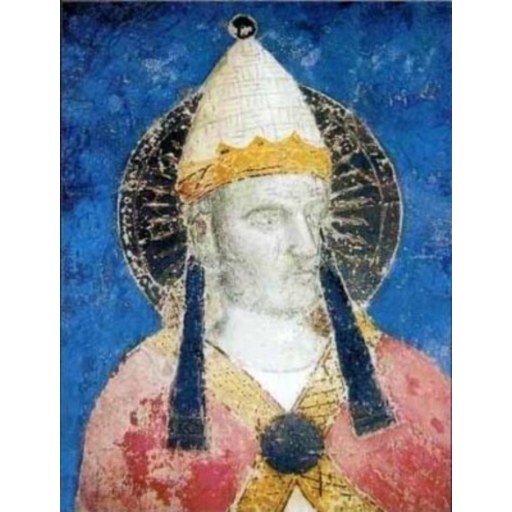
Eccekevin (talk)
License: Public domain
Gregory X
Blessed- Life Span
- d. 1276
- Feast Day
- 10 January
- Gender
- male
- Church
- Catholic
Places
Relics & Where to Venerate
Location unknown
The bodily remains of Gregory X are a first-class relic. Venerated at Tomb of Gregorius X.
Roles & Family
Canonization
Biography
Teobaldo Visconti, who took the name Gregory X upon his election to the papacy, was born in Piacenza in northern Italy in the early thirteenth century. He belonged to a prominent local family and pursued an education in canon law, spending time in France and serving the Church as a secular cleric rather than as a member of a religious order. By the 1260s he had become archdeacon of Liège in the Low Countries, a significant ecclesiastical office that involved him in the administration of a major diocese. He was not a cardinal and had not yet been ordained to the priesthood when the events that brought him to the papal throne unfolded. In 1270 he accompanied the Lord Edward of England, later King Edward I, on crusade to the Holy Land and was at Acre when news of his unexpected election reached him.
The papal see had been vacant since the death of Clement IV in 1268, and the cardinals assembled at Viterbo had been unable to agree on a successor for nearly three years, the longest interregnum in the history of the papacy. Under pressure from the local authorities and the faithful, they at last chose Visconti, a compromise candidate who was absent from Italy and not entangled in the bitter factions of the Roman Curia. He accepted the election, took the name Gregory X, and made his way back from the East. He was ordained priest in March 1272 and consecrated bishop and crowned pope later that same month. His relatively brief pontificate was dominated by the twin aims of restoring unity with the Greek Church and organizing a new crusade to recover the Holy Land, as well as by the need to reform the process of papal election so that such a prolonged vacancy could not recur.
Gregory X convoked the Second Council of Lyon, which met in 1274. There the Byzantine emperor Michael VIII Palaiologos, seeking Western support against the ambitions of Charles of Anjou in the eastern Mediterranean, accepted a profession of faith that included recognition of papal primacy and the Latin teaching on the procession of the Holy Spirit. The union was proclaimed at the council but remained largely a diplomatic arrangement; it met strong resistance among the Byzantine clergy and people and did not survive Michael's death. At the same council Gregory issued the constitution Ubi periculum, which established the enclosed conclave as the method of papal election, imposing seclusion and gradually reduced rations on the cardinals in order to force a timely decision. He also obtained pledges of men and money for a crusade, though the expedition he envisioned was never launched. In imperial politics he supported the election of Rudolf of Habsburg as King of the Romans, seeking a counterweight to Angevin power in Italy, and he worked to ease the conflicts between Guelfs and Ghibellines in the Italian communes.
Gregory X died at Arezzo in January 1276 while traveling south from Lyon toward Rome. He was buried in the cathedral of that city. His pontificate, though short, left a lasting mark on the institutional life of the Latin Church through the conclave legislation, which, with later modifications, has governed papal elections ever since. He was beatified by Pope Clement XI in the early eighteenth century and is commemorated as Blessed Gregory X, with a feast on 10 January. His reputation is that of a reforming pope who sought peace among Christian princes, reunion with the East, and the recovery of the holy places, even if the political conditions of the late thirteenth century limited what he could achieve.