Gunter is a saint of the Catholic Church (d. 1045). Gunter's feast day is celebrated on 9 October.
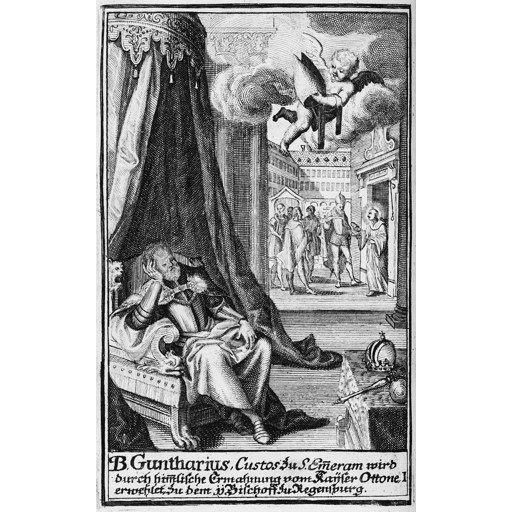
Unknown authorUnknown author
License: Public domain
Gunter
Saint- Life Span
- d. 1045
- Feast Day
- 9 October
- Gender
- male
- Church
- Catholic
Places
Roles & Family
Religious Information
Biography
Gunther was a German nobleman of the tenth and eleventh centuries who became a Benedictine monk and hermit and was later venerated as a saint in Bavaria and Bohemia. He was born in Thuringia about the middle of the tenth century; later tradition assigns the approximate year 955. His family belonged to the high aristocracy of the region, being associated with the counts of Käfernburg and Schwarzburg, and he was related to the Ottonian dynasty, including Emperor Henry II. Until middle age he lived as a secular lord, noted especially as a huntsman, and showed little inclination toward the religious life.
A conversion took place when Gunther was already in his fifties. Guided by Godehard, abbot of Niederaltaich (afterwards bishop of Hildesheim and himself a saint), Gunther gave away his property and received the Benedictine habit at Niederaltaich, most likely in the first decade of the eleventh century. The common life of the monastery did not meet his longing for stricter asceticism, and he obtained permission to become a hermit. After an initial period near the abbey he withdrew, around 1011, into the wilderness of the Bavarian Forest, establishing a cell at Rinchnach.
A group of followers gathered at Rinchnach, which in time became a priory of Niederaltaich. Gunther practised extreme poverty, fasting and prayer, and is described as having laboured among the Slavic population of the forest marches. He enjoyed the esteem of the dukes of Bohemia and is said to have travelled to the court of King Stephen of Hungary. The sources present him as a man of unlettered piety rather than as a prelate or scholar.
In later life Gunther sought still greater isolation, apparently residing in the Bohemian Forest. He died on 9 October 1045. A cult developed quickly; his feast is celebrated on 9 October. He was never canonized by a pope according to the procedures that later became standard, but he has been recognized as a saint in local calendars and Benedictine tradition. Reliable contemporary evidence for the exact place of his burial and for many particulars of his life before conversion is limited, and later legends must be treated with caution.