Guntram is a saint of the Catholic Church (d. 592). Guntram's feast day is celebrated on 28 March. Guntram is the patron saint of divorced people;guardians;repentant murderers.
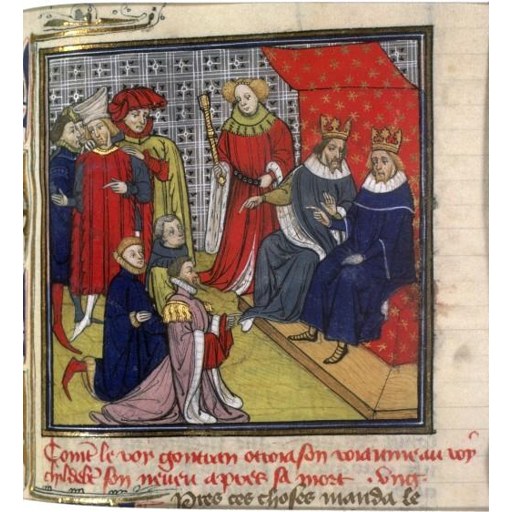
License: Public domain
Guntram
Saint- Life Span
- d. 592
- Feast Day
- 28 March
- Gender
- male
- Church
- Catholic
Places
Relics & Where to Venerate
Location unknown
The bodily remains of Guntram are a first-class relic. Venerated at Chalon-sur-Saône.
Roles & Family
Religious Information
Patronage
divorced people;guardians;repentant murderers
Biography
Guntram (also Gontran, Gunthramn, or Guntramnus) was a Merovingian king of the Franks, a son of King Chlothar I and Queen Ingund. His exact year and place of birth are not recorded in contemporary sources and are known only by later estimate. When Chlothar I died in 561, the Frankish realm was partitioned among his four surviving sons by the custom of partible inheritance. Guntram received the portion centered on Orléans, a territory that included the old Burgundian lands and much of east-central Gaul. He is therefore commonly styled king of Burgundy or king of Orléans. His brothers Charibert I, Sigebert I, and Chilperic I received Paris, Austrasia, and Neustria respectively. After Charibert died without surviving sons in 567, that kingdom was divided among the three remaining brothers, enlarging Guntram's share. He kept important residences at Orléans and especially at Chalon-sur-Saône, which became a favored royal seat in the later years of his reign.
Guntram's family life is known chiefly from the Histories of Gregory of Tours. He first had a son, Gundobad, by a concubine named Veneranda. He then married Marcatrude, daughter of the magnate Magnachar. Gregory reports that Marcatrude, jealous of Gundobad, caused the boy's death by poison; Guntram repudiated her, and she died not long afterward. He next married Austregilde, also called Bobilla, who bore him two sons, Chlothar and Chlodomer. Both princes died of dysentery in 577 while still children, leaving Guntram without a surviving male heir of his body. Austregilde herself died in 580; in grief Guntram had her physicians put to death, an act later tradition treated as a sin for which he sincerely repented. Daughters are also mentioned in the sources. Lacking sons, he adopted his nephew Childebert II, son of Sigebert I and Brunhilda, as successor. The adoption and related territorial settlements were confirmed by the Treaty of Andelot in 587.
Over a long reign Guntram was repeatedly drawn into the wars and intrigues that divided the Merovingian family. He opposed Chilperic I and Fredegund, allied with or quarreled with Brunhilda and Childebert II, and faced the pretender Gundovald, who claimed to be another son of Chlothar I and who was killed after seeking support in southern Gaul. Guntram also sent forces into Italy against the Lombards, with limited lasting success. Gregory of Tours, who had personal dealings with the king and is the principal narrative source for the period, presents Guntram as the most conscientious of Chlothar's sons: accessible to petitioners, willing to hear bishops, and concerned to punish injustice. The same author already records miracles associated with the king in his lifetime, which encouraged a reputation for holiness in sixth-century Gaul. Guntram supported episcopal authority, endowed churches and monasteries, and took part in the religious life of his kingdom in a manner that distinguished him from more purely secular warrior-kings of his house.
Guntram died on 28 March 592 after a reign of some three decades and was buried in the church of Saint Marcellus (Saint-Marcel) near Chalon-sur-Saône, a sanctuary he had favored and enriched. He left his kingdom to Childebert II. Veneration of Guntram as a saint grew from Gregory's portrayal and from the cult at his tomb. The Catholic Church commemorates him on 28 March. He was not the subject of a later papal canonization under the procedures of the second millennium; his cult belongs to the early medieval recognition of holy kings in Gaul. Later devotion invoked him as a patron of divorced persons, of guardians, and of those who repent of homicide, associations that reflect both his marital history and the episode of the physicians. Many details of his birth, inner court, and private motives remain unknown; what can be said with confidence rests largely on Gregory of Tours and on the political record of the Treaty of Andelot and related Frankish affairs of the later sixth century.