Habakkuk is a saint of the Catholic Church. Habakkuk's feast day is celebrated on December 2 (Eastern Orthodox); January 15 (Roman Catholic).
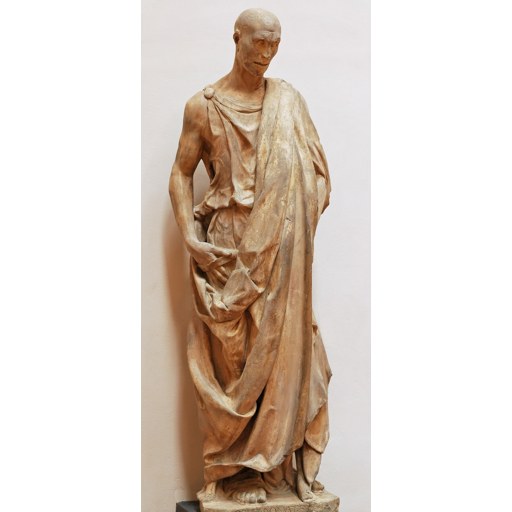
License: Public domain
Habakkuk
Saint- Feast Day
- December 2 (Eastern Orthodox); January 15 (Roman Catholic)
- Gender
- male
- Church
- Catholic
Relics & Where to Venerate
Location unknown
The bodily remains of Habakkuk are a first-class relic. Venerated at Habakkuk Tomb (Kadarim).
Roles & Family
Biography
Habakkuk was a prophet of the Kingdom of Judah and the attributed author of the Book of Habakkuk, counted among the Twelve Minor Prophets of the Hebrew Bible and the Christian Old Testament. The biblical book supplies no genealogy, birthplace, or explicit chronological heading, so the prophet's personal biography cannot be reconstructed from contemporary records. Internal evidence, above all the announcement that God is raising up the Chaldeans (Babylonians) as an instrument of judgment, has led most modern scholars to date his activity to the late seventh century BCE, commonly during the reign of Jehoiakim (c. 609–598 BCE), after the collapse of Assyrian hegemony and before the Babylonian capture of Jerusalem in 597 BCE and its destruction in 586 BCE. Alternative datings to the time of Josiah or to the early exile have been proposed but remain minority views. The prophet's name is of uncertain etymology; it has been connected with a Hebrew root meaning to embrace and with an Akkadian plant name, but neither derivation yields biographical information.
The Book of Habakkuk is unusual in form among the prophetic writings. It opens as a complaint or lawsuit in which the prophet questions why God permits violence and injustice among Judah's own people and why a still more ruthless empire should be chosen as the means of punishment. Divine answers follow, including the statement that the righteous shall live by his faith (Habakkuk 2:4), a verse later cited in the New Testament (Romans 1:17, Galatians 3:11, Hebrews 10:38) and of major importance in Jewish and Christian theology. A series of woes against the oppressor occupies the remainder of chapter 2. Chapter 3 is a prayer or psalm, marked with liturgical terms such as Shigionoth and Selah, which many scholars consider a distinct composition that was joined to the oracles in transmission; in Jewish tradition it has been associated with temple worship. The book thus preserves both a theodicy dialogue and a cultic hymn rather than a conventional collection of oracles against Israel and the nations.
Later religious literature expanded Habakkuk's story far beyond the biblical text. The Greek addition to Daniel known as Bel and the Dragon relates that an angel carried Habakkuk by the hair from Judah to Babylon so that he might bring a meal to Daniel in the lions' den. The pseudepigraphical Lives of the Prophets and various rabbinic and Christian hagiographical notices offer further legendary details, among them purported tribal affiliation (sometimes Simeon), a birthplace, and a burial site, but these cannot be verified historically. Christian churches commemorate Habakkuk as a saint: the Eastern Orthodox Church on 2 December and the Roman Martyrology on 15 January. Several localities, including Huqoq in Galilee, a site near Tokat in Turkey, and Tuyserkan in western Iran, have been claimed as his tomb; none of the identifications rests on evidence from the prophet's own era.
Because no extra-biblical inscription or securely dated notice of Habakkuk survives, statements about his family, occupation, or death remain conjectural. He is best understood as a Judahite prophetic figure of the late First Temple period whose short book records a theologically searching dialogue on divine justice amid the rise of Babylon. The influence of that book has far exceeded its length: Habakkuk 2:4 became a key text for Pauline theology and, in the sixteenth century, for Protestant reformers, while the prophet's lament and vision continue to be read in Jewish and Christian liturgy as a reflection on faith in times of historical disaster. Habakkuk therefore stands less as a recoverable historical personality than as the voice of a brief, distinctive prophetic book whose questions about suffering and empire have been continually reused in later religious thought.