Hadrian is a saint of the Catholic Church (d. 306). Hadrian's feast day is celebrated on 8 September. Hadrian is the patron saint of soldiers;butchers;prison guards;arms dealers;plague;epilepsy;Geraardsbergen.
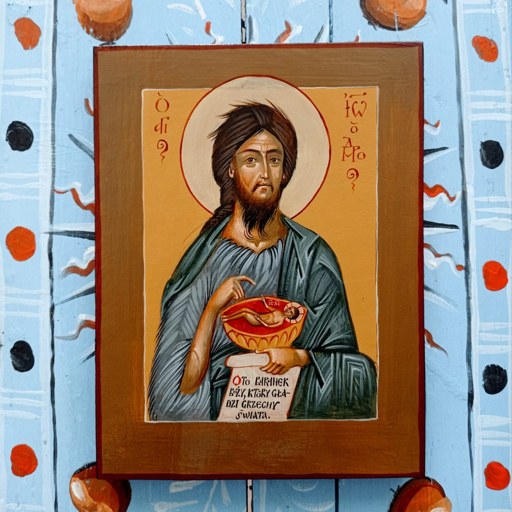
https://www.etsy.com/uk/listing/1518487637/saint-john-the-baptist-picture-icon
License: unknown
Hadrian
Saint- Life Span
- d. 306
- Feast Day
- 8 September
- Gender
- male
- Church
- Catholic
Places
Roles & Family
Religious Information
Patronage
soldiers;butchers;prison guards;arms dealers;plague;epilepsy;Geraardsbergen
Biography
Hadrian (also known as Adrian) of Nicomedia is venerated as a Christian martyr of the early fourth century. According to the traditional account preserved in later Greek and Latin passiones, he was a high-ranking officer—often described as a member of the imperial guard or a leading official—at the court of Nicomedia, then a principal residence of the Roman emperors in the East. Nicomedia, in Bithynia in northwestern Asia Minor, was a centre of the Diocletianic persecution. The legend relates that Hadrian, still a pagan, was so struck by the constancy of a group of Christians under torture that he declared himself a Christian and was immediately arrested. His birthplace and year of birth are not recorded in any source that can be treated as historically reliable, and even his existence as a distinct historical individual is known only through later hagiographical tradition rather than contemporary documents.
The same tradition makes him the husband of Natalia (Natalie), herself later honoured as a saint, who is said to have encouraged him in prison and to have recovered his relics after death. Hadrian and his companions—the number is often given as twenty-three—were subjected to extreme tortures, including the severing of limbs, and were finally beheaded. The date commonly assigned in martyrologies is 306, during the reign of Galerius or in the closing phase of the Great Persecution, though the passio is a late and largely legendary composition and cannot be treated as a contemporary historical record. His death is firmly located by the tradition at Nicomedia. Natalia is not described in the standard accounts as the mother of children by Hadrian, and no offspring are documented.
Natalia is said to have taken Hadrian’s body to Argyropolis, near Constantinople. In later centuries relics associated with him were claimed at Rome, where the former Curia of the Senate in the Forum was consecrated as the church of Sant’Adriano, and in the Low Countries, especially at Geraardsbergen (Grammont) in present-day Belgium, which became a major centre of his cult. The Roman Martyrology commemorates him on 8 September; Byzantine calendars keep his feast on 26 August, and some Western sources also note 4 March. He was never the subject of a formal papal canonization of the later medieval or modern type; his cult is of the ancient, pre-congregation kind.
Because of his military rank in the legend, Hadrian became a patron of soldiers, prison guards, and related trades such as butchers and dealers in arms. He has also been invoked against plague and epilepsy. His cult was particularly strong in medieval Flanders and in Rome. Modern hagiographical scholarship treats the detailed narrative of his passion as legendary while accepting that a martyr named Hadrian (or a group of martyrs) may have been commemorated at Nicomedia from an early date; the precise historical circumstances of his life and death remain uncertain.